 GreenMedInfo
 Regenerate
 Ancient Futures
 Scalar Flower
 Sayer Ji


Vaccines, from Sayer Ji’s channel
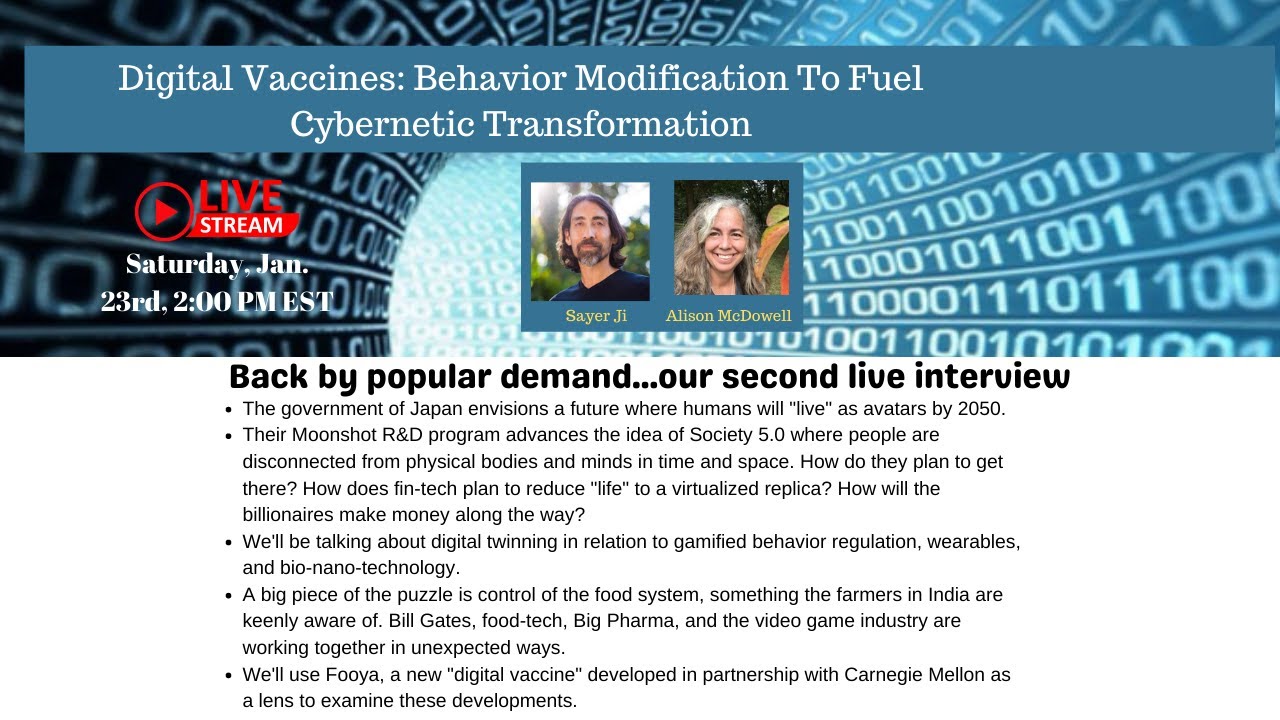
[UPDATE! Part 2 going live on Saturday, Jan 23rd, 2 PM EST:
Published December 26, 2020 · watch on YouTube.
Open each topic on GreenMedInfo to read the study abstracts it draws on.
TranscriptAuto-generated from the video’s captions; may contain errors. 34,622 words.
All right, welcome everybody. I'm so excited to have Allison McDow here and I just wanted everyone to know a little bit about why I'm excited and that is because I've met only a few people like Allison in this uh journey which is my life who have seemingly figured out the meta context for really what is being architected all around us uh under if you will the you know um COVID response uh sort of notion and I started to read your workouts and probably only it was
actually the fourth industrial revolution video series that my wife Kelly brought to my attention and it just blew my mind and opened up so much context and so I was so excited to reach out to you. Thankfully, you responded and you've been working on really just um helping to bring people, if you will, this is a metaphor that's overused, the red pill, but with your incredible heart centered uh you know, energy that that that's the part that excites me because Kelly and I go deep down
the rabbit hole ourselves and oftentimes it's so toxic and you just don't right, you just don't know what you're doing because if you share it and people aren not ready, they they can really get upset and traumatized. And with you, your energy to me is such a great um embodiment of what I know Kelly and I are working towards, which is to bring people awareness, but then not freak them out and also deliver them some promise and some, you know, model for how to engage the
information positively. Uh so I am so excited to have you. Um, today we are going to be covering a number of topics and I think the viewers will very soon see that the best thing to do is just sit back, let Allison take the wheel. Occasionally I'll ask a few questions maybe to connect it to our audience. But um, Allison, I'm just so happy to have you and I just want you to take the take the floor here. Take take over. Oh, well, I'm I'm really
grateful. Um ju just by way of background, I'm based in Philadelphia in the United States and um I actually got into this um my my background, my training is is um in art history and actually historic preservation. So I'm I think I have a skill set of doing primary source research and then knitting things together and looking sort of symbolically at um things going below the surface of what's actually happening and then connecting it together. So that's that's the the skill that I bring. Um, I
think in some ways I'm I'm really appreciative to have your, you know, to be invited today because I know that you have a very uh large listenership and and readership and this is information people need to know because it's very deceptive the the ideals that are being advanced as um being built around justice and equity and um you know my lens is coming more from I say I was a recovering liberal and now maybe recovering leftist at this point I'm sort of politically homeless you know
because I the pe all the things I thought like that everyone would be with me at this point aren't. So I'm I'm really just out um people sort of talk to talk about me like I'm a scout like out on the horizon like I'm going out to sort of tell people what what is out there and to give them information. So um it's overwhelming I will say um and I talk fast and I apologize and have a lot of material. So those are all of my
personal foibless. So just bear with me know that we are all human and we all have things we're good at and things we're less good at. Um but this will be recorded I'm sure I will share the slides and um it's almost like learning a new language and a lot of it has to do with uh financial structures um and derivatives products which are not easy to understand. Most people do not understand them unless they're in that industry and some of it won't seem to make
sense. But I would encourage you I have my own YouTube channel just Allison McDow YouTube. It's really a basic little channel but I have a whole series of playlists with other interviews. So, if you're interested, you can go there and just really, you know, I've had people tell me like they go to sleep listening to these podcasts, which is really just kind of funny to think about, but um it takes some time. So, give yourself some time and realize like it'll it'll take a few listenings
to to get there. So, um again, I'm here I'm in this um city. It's a it's a predominantly black city. It's a very poor city and we are um a target of a lot of this social impact investing that I'm going to talk about um because we are surrounded by u very affluent area of Pennsylvania the main line and um a large um character in this sort of unfolding saga is the University of Pennsylvania and Wharton Business School not exclusively but um they play a major
role and that is that is here in Philadelphia. So there are things that I have researched and I came into this through advocating for public schools against school closures um and realized that it wasn't just about um using data to um privatize schools and to tr to take profit off of children in schools that it was something much larger. It was part of these larger derivatives games that were going to be set up and that it wasn't just education. It was essentially every single public benefit
service um would be privatized and subjected to these investment markets. and that includes health and wellness. So health meaning um you know physical health but also mental health and addiction treatment. So these are all things that um I'm going to try to bring to today. I haven't had a chance to really speak to that a lot up till now but I think it's really important. Yeah. So for those who are sort of new to this concept around um let's say first the weaponization of public health
I know that my focus as well as Kelly's has been on helping people understand that you know when it comes to germ theory for example it's really been weaponized and wielded as a geopolitical instrument and there are all these reasons why we can see this is happening you can call it biopolitics yeah way of controlling you know the masses and we can also look at it from the lens of um profit. But what the piece that you have brought to the table that's so powerful is
understanding again the datification commodification of humans and human behavior and how that works with these social uh impact uh investments and then how it gears into sort of the AI world that's descending on us. So, um, I just wanted people to understand that there's a really key missing piece here that you're bringing to the table that while at times it's like a lot of data and it sounds really obscure. Uh, just hold tight because I think it'll start making sense. Um, especially when Allison does the
presentation. Yeah. And I will just say too, if people have not seen the film The Big Short, which is is a a film that sort of outlines how the last global economic crash happened with the the real estate and the mortgages and these asset back securities, that is a really helpful because they're actually it's a very educational movie on how that all happened and and to understand the culture of the these trading houses and how it works. So, you know, understanding just in the framework that
the next um big short futures market isn't just toxic bundled mortgages, but is actually going to be um debt um public uh benefit debt tied to human beings and children and um so so it is I think in very much it's a it's a we are in this moment of um like sacred and profane is sort of how I'm I'm framing it is and I I do feel that it is a a spiritual um engagement And um you know I have I'm sort of a conduit
for a lot of information. I'm not you know I'm benefiting from amazing teachings from many people both spiritual teachings and guidance and also um I will credit largely just upfront I want to mention um Joseph Gonzalez who is a um uh the first person I ever met um in the weird interweb world who understood the implications of a blockchain smart contract in financial investments. So he's he's um spent 30 years career in AI and gaming and um blockchain and so we could really we've collaborated a
lot and we have a whole webinar on on that. So that's another piece that I'm excited to have you speak to uh throughout this presentation because there's so much uh exuberance around the blockchain and cryptocurrencies like Bitcoin and the dark side of that I think you're really bringing to the foreground. Why has institutional money now shifted the narrative where now it's all investing in this sector and there's a there's a shadow to that that I know you've helped to bring to light and then as far
as the spiritual aspects of this conversation. You know what I've been noting is almost like an ontological speciation event where we're going from those who are aligned and who've been allowed themselves to be captured by this digitalization of life in general and those who know that nature and plugging into the rhythms of the body. It's it's so essential that we stay plugged in especially while we navigate this global web that you're about to expose because otherwise we can spin out and and lose our center and
become like the monster we are fighting as Nietze used to say. Exactly. And I, you know, the my other framing that is somewhat unique, I think, you know, I'm I'm hoping we'll catch on or but you know, but I'm in Philadelphia and um you know, so we're the the home of the Declaration of Independence and the Constitution and um you know, I I I really I you know, I appreciate the resistance efforts to these lockdowns and this controlled global demolition of the economy and you know,
all the work that that is being done in that sphere. Um I will say much of it is being framed around relying on these instruments um the constitution and the founding fathers sort of a a patriot narrative and I would just say um there are quite a few in Philadelphia who've tried to surface some of the issues around the constitution that you know it was never inclusive of all people and particularly what we're coming up against I believe is more digital enslavement and in in many
respects people being pushed out of their economic independence into a dependent on the state which is very similar to what um our nation did to indigenous peoples, right? We removed them from land and we put made them dependent on the government and then we we did not the government did not fulfill its obligations to its people. And so in that context, I just want to sort of frame that that is h what I bring to this is that um to questioning some of these underlying fundamental
narratives because I think in order to fully grasp um that what is happening isn't an aberration but actually a logical extension of where we started but that there is a moment of redemption like there is this moment like we are in this breaking down of everything. You know, in my heart, I feel like maybe there's the chance that Philadelphia gets a doover. Like maybe there's a chance that we could authentically make a world that is right and caring for the sovereignty of all human beings and
all children. And um so anyway, yeah, I just wanted to add that, you know, what I find so compelling about this sort of conversation is that, you know, it's like that phrase about a text without a context as a pretext. And it's the historicity that you're bringing to the forefront. uh some might call it karma, right? Cause and effect over many generations. I understand that to mean is once we learn the lesson, right, then then we are able to graduate and be redeemed. And so that's
the that's what I feel is so powerful about what you've brought, Allison, to this conversation is that meta context that honestly I have not heard anyone else speak to um out there. I know there are others, but you're you're you're really the one so far for me. Yeah. Well, and I I feel like I'm bringing these messages. I would I would encourage too and maybe we can drop a link in the talk later, but there's actually a very formative speech um by a a professor at
UC Santa Barbara. His name is Justin Leroy and it's um about social impact bonds and it's I think race, finance and the afterlife of slavery and it is very much about the the financialization of um the slave trade particularly the domestic slave trade and you know sometimes I actually even imagine that like maybe the people at Wharton are they looking at early 19th century like financial transactions in you know human bodies to to set up this new system. Um, so you know, again, I'm I'm bringing
forth a lot of teachings that I've benefited from many other people and hoping that it resonates with folks. Yeah. Whether we like it or not, everyone has tasted what it feels like to be enslaved or imprisoned in this quote uh pandemic. So what you're speaking to isn't academic. I mean, we're all now experiencing the digital prison as you've also described it. Exactly. So So let me see. Do you want me to bring up the Can you bring up the slides or do I bring up the
slides right now? There we go. Cool. All right. So, anyway, so I call this performing wellness um because what I really want to talk about a little bit is about um both the financial structures that are being embedded in um the Medicaid and Medicare systems and the health care systems that is going to be framed as preventative health. Um but the preventative health and I I know that you guys are very, you know, familiar with like the terrain theory. They're not going to clean up the
world to make it healthy so we can live in it. are going to continue to poison the world and make us operate in this sort of poison toxic dangerous world and then they're going to bet on our our performance in that. Um, so let me and then they're going to blame a quote viral particle for all of those conditions, right? It's it's amazing to have an invisible enemy, right, that you made up in an equation, you know, in computing. So, I just just for framing this
um you know, I threw this out last night because I sort of I was working on my slides up. I was up really late and then up early and um you know I was just trying to figure out is this are are we already in the my friend Joseph already talks about we're in the game we're in the game and I'm like is AI in charge like general artificial intelligence like is this is this um the cosmos is it AI like who is who is running
this because I've you know continually have interesting things happen to me and come across the paths of of people who are helping me on my journey and it's it's it's interesting to s sort of debate the mechanistic aspect versus the the natural energetic aspect. Um, but this is someone's response to my my tweet asking about that and they said, you know, maybe it's like this crazy Hollywood be movie with all of these paths. You know, it's like those books, I don't know, I had them in
middle school that were choose your own adventure and you'd read and then you'd flip and they'd say, if you want to do this, go to page 77. If you want to do that, go to page 102. And you'd flip. And so, you know, there were all of these different optional endings. So, even though um what I'm putting forth sounds seems very um m like it seems like they have all the cards, I really don't think they have all the cards. And I do believe that in
my heart that that the creator of the world would not want us to all be wiped off the planet and turned into batteries for a matrix of an AI. I I don't believe that ultimately that that is how it will go. And if you haven't read I, you know, I try to read it once a year. Um, but uh, A Wrinkle in Time is a book that I read. It's a children's book and it's kind of complicated because it actually talks about sort of quantum physics
and space and and ultimately that in the end it is they are prevailing over technocracy. It is this that the the evil force is called it. And um, and what prevails over it is love. It is a love of a of a girl for her brother. And that is what what overcomes what seems like the impossible. And so I I have I have a you know one of one of my friends and adviserss but he he promises that there is an amazing gathering in the valley
of love after the zombie apocalypse. So I'm kind of going with that that maybe it's all fixed out there somewhere already and we're just sort of going through these different quantum you know dimensions along the way and doing our crazy terrible Hollywood be movie version and and we will get there. But that's sort of my my intro framing. And then also one of the other people that I draw on a lot is um who I believe is really a prophetic voice for this moment is is
John Trudeell and also his wife Tina who was um murdered in a housefire with her children. And I think in many respects the indigenous worldview is um has always been a direct threat and confrontation to this mechanized so-called enlightenment um scientist version of the world. and and John Trudeell has amazing speeches, but one of the things that most resonates is that he says that we have a responsibility to use the intelligence given to us by the creator to go up against this machine of technologic and
we're not the first. Other people have put themselves up against this machine of technologic puts a hyphen technologic. Um but that we have to be thinkers that we can't just sit back and and believe because believing is passive and thinking is active. And so I do feel like those of us who can see what is unfolding right now um that we should take that into our hearts and and even you know though it you know these challenges can really get us down to know that we're
we're doing this important work like if we can see it that we are here to do this important work. If I could add to, you know, the thing about the binary uh sort of cortex, it's it's totally perfectly complimentary and and you know, capturable by the the technocratic system, but the heart as you're speaking to is not and it is infinitely more intelligent, can grasp infinitely more. So that's where I really love what you're saying and and just would remind people out there that that's really
the answer to how we overcome this. It's not going to make sense up here, but it will in the heart. I think so. And I think well I'll talk a little bit more about like energetic and electrical systems later on because I do think and I I'm I'm I'm learning more. I've learned so much during this process. Um but that that energy flows is is is very central to all of what's coming while all of what has happened in the past and all of what's sort
of flowing forward. Um so this is actually um I would encourage and maybe we can include this link as well. This is from my education world. Um but when I was doing research around education and education technology there was a rabbit hole and it was called an entity called global education futures forum and the head of this his name was Pavlexia he was based out of Skolko which is like the Silicon Valley of Russia and he's a transhumanist and so they had developed with individuals rep
from all over the world very influential the the one for the United States his name was Tom Vanderarch and he had formerly worked for the Gates Foundation and they created a lot of infographics IC sort of anticipating what education would be like moving forward. And so this is a just a screenshot that clips out a piece of one of these maps. But you can see um you know I've circled this new models of human capital investment. So that is an indication of these new human capital
bonds that have really been in the works somewhat since the mid 1990s, but now that the technology with the blockchain identity and the 5G, it's ready to to come on at scale. Um but you can see even above there's like this prenatal university like prenatal education and I want to emphasize that so much of this that is coming is based in um genomics and biioinformatics but it is steeped in eugenics okay it is steeped in this idea of um controlling people's lives based on their their
DNA and this this the sense that you can engineer someone to be an optimum human um that that is something that these individual uals with all of this demented power feel like that they have the right to do that to people either through digital technologies or potentially um nanotechnologies and bioengineering. Um so so the framework of both enslavement and um indigenous eraser is really important. So again I had mentioned earlier about the um the the Indian reservations and actually this is another piece I'm in Pennsylvania.
So Carlilele um residential school which was essentially these schools where they you know took children is right here. I I actually took my family there, but it's it's still on the grounds of the Army War College, right? So, this war against indigenous people continues to be waged and it has this long legacy. And so, I know a lot of us are talking under lockdown about concerns about food security, right? Controlling the food source. And that was one way in which um the government like when they
put people onto these reservations made promises about annuity payments that they could eat and then they would deny them and withhold them. And this is an individual who had had said, you know, that they could just eat grass, that the Lakota can eat grass. And what ensued after that was actually the Dakota um there were they called it the Dakota wars for and and as a result actually on this date and this is why it's so significant like there are these synchronicities, right? You know, on
this date in 1862 was the largest mass execution that was carried out in Mano of the Dakota who had defended themselves and their families from being trapped on these reservations on these concentration camps essentially by the US government and that was authorized by Lincoln. So when we understand this history that that's why I'm sort of trying to surface this is that we are doing this work now not just in the effort to protect our ourselves and our families and our communities and future generations from the
prospect of potentially fun be being fundamentally shifted into transhumanism or synthetic biology or bi but that we're actually um doing this work for the ancestors right for the those who went before who did not get justice. And and that's that's what I try to bring. And if I could just add real quick, Allison, is that we reported recently on the CDC having a page on their site that talks about confinement centers called green zones that would be set up for high-risk COVID populations. And you know,
arguably that wouldn't just be for those who are elderly or, you know, minorities, but who haven't taken, say, for example, the mRNA vaccine or haven't subjected themselves to these uh tests that don't actually work. So, you know, it's not like there isn't a parallel occurring now because perhaps we've never addressed our our history as you're saying. So, just and I mean the the you know, there was a a there was a political economy built on empire, right? It was our domestic empire uh that of of
through you know various broken treaties fraudulent you know of acquiring the land to roll out this nation right and and and to the detriment of of those individuals there is an economic reason behind it. Now we are seeing an economic reason that the billionaires are looking to build a world of fourth industrial revolution that's run pretty much by themselves and their robots so that they can have a resort of the world with very few people. And so there's not a need for people on the land
anymore to be doing labor to be doing industrial manufacturing to be being teachers and doctors. They're going to put most of that online and they don't care if a lot of people die as a result. and and you know that connects into Agenda 21 and the removal of people off of land into sort of mega city regions. So, you know, it is very consistent with what's playing out. And I just want to say like this visual for me um I spent some time um in South
Dakota on Lakota land this summer and I was seeing spiderw webs all the time. There were these amazing I spent some time trying to work on on making a garden there and one of my first days I was clearing um it had they had plowed some of the or cut the grass and and we were creating beds and um I I left my glasses and there was some trash that had blown in because it's very very windy there and and it doesn't go away so it
gets caught under the sage brush and so I was picking up sort of trash after the grass had gotten moaned and I didn't have my glasses on and I reached down in the grass and I thought it was something like a brillow pad or some fluff like a cushion fluff or something like that. And I realized it was a like a bazillion tiny baby spiders there in the grass and like all throughout that I would water in the dusk and it was all of these little
little ground spiders. So, you know, for me it's a lot of it is how do you talk? They talk in symbols, right? They use symbolic language. They use symbolic visuals. And I I want to use these two images to sort of convey through the course of my talk the the the people who would like to bet on our lives and control us and put us in little confinement so that AI can learn how we operate and learn us and and limit our lives, restrict it into
these tiny little spheres like we're all, you know, sitting in our little rooms. That is this crazy pathway. I think it's somewhere in Spain. It's like the world's most dangerous path. And they'd like to keep us isolated and keep us on the pathway. Now they can maybe say we can go fast or slow on their pathway but it's their pathway and we can't get off. That is the version of the world that they're trying to impose with blockchain identity. And what I'm saying is is that
there's a beautiful like universe natural universe of of represented by the spiderweb an interconnection of um different paths and the ways in which spiders actually also consume their their webs and then respin. And so to me in my mind that that if we're aspiring like keeping in mind an aspirational goal, it is is more towards the the interconnected spiderweb of of our lives connected with others having multiple paths and multiple options and multiple redos, right? Because we're all human and we're going to fail and and
and we shouldn't be stuck on a path um of that sort. That's where they want us. That's where the AI wants us. So, in January, I actually went down to um uh Dallas and Tulsa to to give a talk to some friends about blockchain education. And um my friend Lynn, who's wonderful, and we were in the car on the highway in Dallas, and I'm like, you know, I'm trying to figure out how to tell people what this is like. And I said, the best I can
imagine it is, I said, imagine like we're in a mixed reality video game, right? Like a Pokemon Go, right? So, it's like a video game, but it's also Pokémon Go. It's in the real world. And it was set up by these, you know, business people, the the Ivy League, because we're supposed to respect them because they have fancy degrees. And these Ivy League MBAs, they've put up the money for this game, but it was actually built by state surveillance um interests and defense contractors because much
of the gaming and simulations world come out of defense contracting in Hollywood, right? So that's the SCOP piece. So they're like, "We can brainwash you. We have really sophisticated technology. We're going to put you in our game." And then that game runs to make money for these hedge funds which are not that is not money that benefits people. That is money that concentrates wealth and power in the top tiniest percent and then leaves everyone else dispossessed. And so they're going to put us on in the
game and then they're going to place their bets on if we will perform the right behaviors. And those behaviors are going to be aligned to the United Nations sustainable development goals of which health is number three. So good health that is one of the behaviors. That's goal three. And then in as we play the game, we will be given this digital script. That's the digital cash wallets. Um and the corporate state. So this is the state but it really is fascist. This is your government run
by Google and Goldman Sachs. So they will give you script if you behave in their maze. and that the people who are managing this maze are the the nonprofit entities and also the faith communities because many of these powerful faith communities also have large pools of assets including the Vatican because we've seen recently about their their alliance that they've made for inclusive capitalism and that they're the dungeon masters. So just like sit with that for a minute and and that's what we're looking at. And I
know it seems outlandish, but I make these maps and this to my best ability is my understanding of where things are going. Allison, have you seen Social Dilemma on Netflix? I haven't watched the whole thing. I mean, anything on Netflix, you know, is doing their work. I mean, I agree, but that was what was so crazy about it was they showed this digital twin concept and and it's a grotesque horror. So, I just was just going to confirm for those who think this sounds crazy, it's
actually being documented out there even by these very big tech firms that are in collusion with with the project. Yeah, I would say I know like Shashana Zubof gets a lot of traction out there. I mean, she's a professor from Harvard Business School, so clearly she's sitting at the table of the people who are building this machine. And I know that she's actually she was at a gathering with Kevin Wearbach, who I'll talk about later, from Wharton. Um, another book that I I do recommend is
Surveillance Valley by Yasha Lavine. And he really frames um the internet as a military enterprise. And so I think those of us who lean more towards like an anti-imperialist peace framing um that that book is very vital and it also plays into some of the discussions around blockchain moving forward. Um can you find liberation in the master's tools? you know, can you um navigate um are you going to find freedom in um a technology that is fundamentally militarized? And and to me, you know, I have
my own personal understanding that I would say no. Maybe other people are still convinced that it could be otherwise. Um but in this I just want to say, you know, Gates provides a lot of cover for other people. Um Michael Bloomberg, I think, is perhaps even more dangerous. Um and these two are have, you know, teamed up. they they've collaborated together that they worked on the domain awareness system for New York City um which was their um coordinated uh facial recognition camera security apparatus um they
go way back. So these guys are a formidable pair. You know, Bill Gates, his his job is to get us all tagged into the human capital system through the vaccine platform. And he also has side deals, you know, running the GMO foods and the, you know, private for-profit prisons and a lot other things he'll make money on. But his job is to get us on the blockchain. Michael Bloomberg will then run the global police state. Okay? And he will do that. Um, the global police state
will not look the same as we understand the carceral state today. It needs to go beyond the new Jim Crow. The new version will be an open air global prison run um perhaps a little softer, I won't say much softer um by social workers and healthcare providers and your body will be um your prison, you know, in in a sense. So that is their framing is what they would they would like to see it. So next to it though I juxtapose um I I spent some
time like I said in South Dakota actually and that this place is promise right and so that's very symbolic actually and the more I think about it um they don't control I mean literally they don't control that because that's indigenous sovereign land but they don't control the cosmic entities the sky the sunsets even at these microscopic levels and the wild flowers they don't control all of it they control some of it and I think we sometimes get caught up in feeling like they can control everything,
but they don't. They don't control everything. So, this is a very interesting thing to me. And folks who maybe have a more familiarity, you know, the occult um aspects of this, the sort of um uh Freemasonry, uh the going way back is not my strength. But I feel like it is very significant that Michael Bloomberg established his European headquarters in London and which is a center of blockchain. But this was this opened in um 2017 I believe and it's on it's he built it over the
archaeological remains of the this temple of Mithris. Wow. So it's pretty serious. I mean he had money he could build it anywhere right and that is where he built it. And so um so Mithris is is this god of sun justice and contracts. So, I really want to point out contracts because the video game world that they would like us to live in is based on this presumption that the world, our engagement with nature and the physical world and the built environment will be mediated through
digital contracts. Okay? That our ability to um engage or not engage will be predetermined by our status in the world. And we're already seeing that with the mobility biometric passports. But that will go at a scale that we can't even imagine. And in that um Black Mirror um episode nose dive is sort of predictive programming for that. Um you know your social credit score dictates what you are allowed to do in society. So this contract piece and I just found this this morning is very important.
Um the idea of these Ethereum smart contracts tied to social credit scoring is part of the internet of agreements. And this is a company um Metarium also based in London. And and for people who are more familiar than I am in the sovereignty movement is that the understanding is that the the blockchain center needed to be London because that was the center of maritime trade law. Also um just if I could add the city of London is a really important piece of the equation too as
far as understanding who's really controlling a lot of these things. So that's for those out there who wants who want to research this deeper I would look at that too. Yeah. So the maritime trade laws the cloud what is the jurisdiction of the cloud right this is what Yasha Lavine asks who runs the cloud right a certain type a small subset of individuals what are legal jurisdictions for digital twins in the cloud and these are all things that we need to be thinking about it's a
new form of vocabulary and those who are rolling this agenda out are very familiar with it but it's something that we need to become more familiar with so I had mentioned before that this is going to align with the United Nations sustainable development goals. Most people if you have not looked at them you might presume that they are mostly about the environment right that's what extinction rebellion that's what sort of the corporate wrong kind of green has framed it that it is about saving the planet
twothirds of those goals there are 17 are actually about managing poor people they're about managing poverty and so this is about this new version of inclusive capitalism and clearly a hinge in this is managing global health and I did not appreciate this until pandemic hit. I did not know what the trigger for this roll out was going to be. Clearly, it is the pandemic. And so, I'm I'm spending more time looking at the health side. Um because your status essentially, you are presumed to be guilty
of living in a human body. You're guilty because you might be a threat. You might be toxic until you are managed through our technological systems. And in that way, your body can then become the limiting factor in your life experience, right? Where you can go, where you can move. And I'm I'm trying to hopefully if people are listening around um the immigration rights movements with global geo fencing because the individuals involved in this who are remaking nonprofits for datadriven government are um one of the major
ones is Huelet Packard. They're also the ones putting um laptops for digital education all the kids' hands. So Hulet Packard is running the border um biometric border control in Gaza, which is is in my mind fundamentally the pro prototype open air prison. Um so we need to understand that Huelet Packard has remade nonprofits for datadriven investment and that they are running um education sectors. I would not be surprised if they're also in um the healthc care sector and that they're doing border control which at this
point if you cannot prove that you are safe quote unquote as a healthy being with all the right papers you may not be able to leave your house like your geo fencing could be your front door. Your geof fencing could be okay well we'll let you go five miles from your house will you have to stay in your state you know they can essentially through satellite geo fencing control people's ability mobility and all of our care all of our social care has to become platformed for
these deals that I'm going to be talking about um because it all runs on data it all runs on data analytics and that's where again the energetic system the electrical engineering we have to be turned into data these bionary ones and zeros to be processed through these systems to have profit extracted from our bodies and our social relationships. So, the reason that we're losing our education and our in-person education, our in-person healthcare, our in-person therapy is because of these deals because they will need to extract
the data and the predictive analytics out of these online platforms in order to run the next version. Allison, if I could just jump out here a second. So, you know, in this window, I've been doing a lot to try to bring awareness to the fact that they've just redefined our body as a threat to the world basically, you know, because we have a microbiome, we have a vir viral, we have exoomes. So, therefore, we are potentially, you know, bioteterrorist vectors. So the piece that you're bringing
in is so important which is in order to you know roll out this new surveillance era where they're penetrating into the body and then we can talk later about you know sort of the uh cellular colonization which you bring up in one of your presentations. They're now transforming that surveillance into data which is then a new capital market. But it all fits in now so much better in understanding why they would do such a thing because most people like they can't believe they would just do
this, you know, but now it makes more sense um given what you're bringing to light. Well, and the interesting So again, and there's language around it, right? The full Babylon service. I mean, it's kind of in your face what's going on here that they're going to use their data analytics like look, you know, now we're all going to experience everything through our phones for the full Babylon service. And you know it's very strange because I don't like normally like my mode of operation really is is
primary source material like looking at people's LinkedIn looking at World Bank white papers listening to webinars um of what the industry is saying that they're planned. It's not actually hidden if you're willing to synthesize it. And I think the reality is is that most people who are pulling down a six-figure salary in one of those spaces are not in a position to question it. And then most people who are most impacted, the poor, are living their lives and they certainly don't have time to spend weeks
and weeks and months pouring over this material. So I'm in a a really kind of a singular space to be able to do this work. Um, but it also lays on the land in Philadelphia and it, you know, it has this history. And when you talk spoke about the microbiome um I'm I'm trying to remember his name is slipping my mind but in the 1694 this Silian monk came to Philadelphia to await the end of the world with 40 monks and they were waiting for the
woman in the wilderness and they they they were out in what is now the Whis Hicken Park um it's in the city of Philadelphia and they were alchemists and they did very interesting coral singing which I find interesting. And the um the his cave, Kelpius, Johannes Kelpius, the Kelpius cave is still in the park. And the cave is really more like a spring house, right? But there it's an underground room with a door. And there's a monument right outside. It's in the public park you can
go see. And it it's from the Rosacrruian. And evidently Kelpius was the first Rosaian in in um Philadelphia. And um so this monument is from the Rosacruians honoring Kelpius. And it's this granite monument and on the side of it so one day I I went I wanted to go see it and I had connected with someone your some people in your audience may be familiar very interesting guy um does very interesting research his name is Rosb Ben and he's a geommancer but he looks at art
and history and um some of these other like sort of hidden histories and you know he had said his his thesis is that Ben Franklin opened the gates of hell in Philadelphia with Prometheus and it's electrical again, more electricity, which is very interesting. But he had told me about this cave. So I'm like, I'm going to go see this cave. So I saw the monument on the side of this monument, and maybe someone can help me figure this out in Greek written not in spray paint
and not inscribed, but very carefully in Greek. It said Nephil. Nephil as in the side of this monument. Okay. As in these bloodlines that control. So Nephil is a myth. It's a a Greek myth of the cloud goddess and um Ixion had lusted after Hera. So Zeus turned this cloud nymph into a digit a twin of Hera and then she was raped and from that came the centaurs and then and a lot of times now they're talking about cyborgs that it's better to call them centaurs.
And then later like the twins there was there was famine there was um seed the seeds failed the crops failed and and the gold the ram with the golden fleece came to save the the twins but there's this interesting connection of nephili between twins clouds violence hybrid beings children children taken um but then if you actually look it up the NIH the national institutes of health just created a software platform for mapping the micro microbiome called Nephil. Oh, no way. Really? Wow. Yes, that's what I'm
saying. There are these overlaps of like history, symbol, science, but last fall, Penn, which is Ben Franklin's university, just did the first human crisper trials. So, we're really there are all of these layers going on. I'm not trying to be but I think it's significant that there are these histories that that that need to be integrated that that people with who may know have access to other knowledges are are are know this and are using using it. Well, Allison, I just want to point out to
those out there who also have been experiencing this, when we see people dawn these masks, call them uh sub submission signaling, it it is such an occult like vibe because we have looked at the evidence in depth and there's very little but some equivocal evidence as far as them being in any way effective at preventing transmission of community acquired respiratory viruses uh and as well a lot of literature on their potential harm. So the fact that they're being forced on everyone uh this is such a
seemingly you know a cult uh phenomena. So so anyway it's a lot of like spells. I mean early on when I was doing this work before the pandemic I said I almost feel like I need like a background in semiodics because they use language in ways that they say one thing and mean another. And so if if you don't know their true intended meaning of how they talk about things, you will be totally misled, you you know, and I I have a a a lovely community
um elder, you know, who's always she's like, Allison, you need a glossery. You need a glosseries to interpret what they're actually saying, but I feel in some ways this like a spell. They have used language and imagery to cast a spell over so many people and that they have it's it's interesting. Well, well, and finally too, as far as this differentiation between the mythos and the logos, is that there was this bifurcation and then we thought one sector of human experience was just sort of like,
you know, fiction and then this is logic, rationality, what's real. And I think in this window and what you're bringing up with some of these mythological threads is that they've always been connected. And you just look at the etmology of some of the words that they're using and you can start to see what the true intention and meaning really is. So, All right, zoom back down to central banking. So, so it's just it's important to know like if people are like I don't really know really
human capital bonds. Yes. So, this is from the San Francisco Federal Reserve. They are very much in the lead on developing this space and now it makes perfect sense to me. It really just sunk into me last night. Um Stanford W was the epicenter of developing social innovation and much of it was also connected to um engineering and um business analytics and wearable technology. Okay. So if you imagine that the global digital prison run from space is going to like control your body through wearable or
ingestible or implantable tech that the the fact that it's the San Francisco Federal Reserve that is setting up these bond markets that will turn you into data and harvest your data your life force as data through these different devices and and required behaviors that will track your compliance to these beha you know assigned pathways that it would be coming out of the San Francisco Fed and Ian Galloway is a central central figure in this, but it it it comes earlier. This is um Steven Rothschild collaborated
with um an economist at the Minneapolis Federal Reserve in the mid1 1990s to to create the concept of essentially a performance-based government contract. They will change up the names. It used to be social impact bonds, development impact bonds, pay for success, pay for performance. Ultimately, it is about a a a government contract that is tied to data. the payment is is incumbent on a certain data outcome being shown. So, so these human capital performance bonds happen. Um I made these little my artist is my art
is kind of you know basic but I was trying to explain this to people these social impact bonds and so I made a video about two or three years ago and and just trying to lay it out visually but it's important to understand that all of this is advancing on austerity. It's all advancing on global austerity. Both austerity of people of people's personal budgets and deep debt but also austerity in government because what's coming this sort of technofascism relies on the idea of a public private
partnership. If our government, if Amazon paid taxes and our government had money to take care of people's needs, um people who were in need, whether it would be their health or their housing or their education, we would not be in this situation. So, this is sliding in. This has been in the works. As I said, Steven Rothchild and Art Wolnick were working in the mid 1990s. There's been several decades of austerity that have teed all of this up, and it's central. And and you know, I
will frame this. This is a racialized endeavor. This is coming after all of us, but it's a program that runs on poverty and trauma. So the people who are first up and who it's being prototyped on are black and brown people and indigenous people and dispossessed people and refugees. Okay. So it is sort of the global north going after the global south and also going after the poor of our country. So can I add something else? And so here in Florida, I read the 52page document
on how they're going to distribute the co vaccines and they make it so explicit that they're targeting minority groups under the false opices of them being underserved, underprivileged. So everything seems so inverted, but just to confirm what you're saying, it's very targeted to those groups. Yeah. And then I mean and this is to me if we understand that what we are up against is in the near future a sublimation of humanity into some cyborg transhumanist neuro web hive mind scenario. It actually like the differences in
some of the identity politics stuff if we if we're willing to come from a heart space and we're willing to actually understand the history of it. But it's a unifying opportunity. Like nobody wants this stuff that's coming. Nobody. It's a billionaire's project. And then some people are diluted because they're getting a salary and maybe they think that they're going to be kept out of it. But essentially what's happening is capitalism is is moving into the virtual world and taking everything else with it and turning us
into digital twins in the process. And so if we can just communicate that to people like they want to use the partisanship to divide people so that we're fighting each other instead of looking at Davos. They want to push everybody like every single element that would identify like you know whether it's you know women black brown indigenous religious groups they want everyone to be divided and what I'm saying is in any box that they would like to put us in because they want us in lots
of boxes and I'll I'll show you later there the Skinner box they would like to keep us in boxes that no box has all the good people or all the bad people. And so our my task is I you know bad being you know in quotes I guess but our task feels like it is to be able to pull the people who are coming from a space of love and caring of humanity and nature the natural world out of the boxes so that we can face
this challenge that's coming. So yes the public private partnership is central to this program. So the government says we we don't have really the money to do this or we're not feeling like it. We're going to outsource it to a nonprofit and investors, you can front that money. And this this is going to be a little I'm gonna spend a a minute with this. This is the social impact bond structure. Essentially, the entire construct of pay for success finance is predicated on using data to predictively
profile individuals and communities into being future burdens on society. Okay, let me just so that the idea of this structure is that every person is a burden. Some are more of a burden than others on society and they that has a cost attached. Okay? So it's based on data. It's based on machine learning. It's based on profiling whether or not and a lot of that data and the AI is racialized and wrong and bad data, but they're going to do it anyway because they're the ones
running the game. if they can come up with a quote unquote solution in the in the framing of an evidence-based that's their language evidence-based program. Sometimes in the healthcare space they call it valuebased program that has data to show that you have reduced you fixed this person even preemptively then essentially in this space um this reduction. So say say this is incarcerated people which is a huge cost offset. It's based in carbon credit trading. There's this huge cost offset. Whether this cost offset is prison. This
cost offset could be the the um payments to manage people on Medicaid who are diabetic. It could be the cost offset of um undermployment because people are depressed. This is the the b the burden. you're you're predictively profiled and they say, "If we we fix you, we've we've saved you all of this money. Aren't we wonderful with our nonprofit evidence-based program that's backed by investors? Um, can we just have our money back and we're just like a little slice of this for our profit? We don't
need a lot. Just give us a little bit and then look at all of this that you've saved. You've saved a ton of money on your own and we'll just take a little bit." Okay? So, that is the narrative of this this structure. Look, everybody is broken. We're going to fix you. The fix, remember, has to be data driven. So that's why you have to have a Huelet Packard Chromebook or, you know, Chromebook. That's why you have you can't go see your doctor. That's why, you
know, my elderly father with dementia that the Alzheimer's place would only do tea appointments, you know, tell me how that works, right? That's why we're going to be slipping sensors in babies tunics to listen to their parents talk to them because they need the data. Now, this profit in and of itself is not much money. And that's what people say. They say, "Well, it must just they must be doing it JP Morgan Chase and Goldman Sachs out of the goodness of their own heart because it's
not that much money, right? They're not making that much money on it. They're just doing it because they care about kids having prek or they care about people returning from prison having a job or they care about um people having healthier nut more nutritious meals. That's not true. They need it to move their money. And so the big money is going to be in creating hedge fund markets. They are going to securitize the debt on the program investments. They're going to securitize that debt and then
they are going to trade it on global markets. But they cannot run this game of hedge fund trading. Like I said from the beginning, imagine the mortgage, the asset back securities now are toddlers, pregnant women, um the el lonely elderly people, people returning from prison. The debt tied to all of those people is securitized and traded on global markets. And this is not just us, right? Like if you're in these programs, the debt attached to you is being bought up by Soft Bank, the Vatican, the
Saudi Sovereign Wealth Fund, you know, all of these different your pension funds, Kaiser Permanente, TIA, Craft, they're all putting a a chunk of you. You're just part of somebody's portfolio. And that's what it goes back to that that early slide. So, um it may not make sense. It may seem crazy, but if you understand that the whole asset back securities and the collateralized debt obligations of the last time were crazy, they're just making it a game. Okay? But they cannot play this game if this structure
does not exist. So basically the system doesn't exist. They cannot play the game. So that that they must create and be able to scale this. It has to scale. And what they need to scale it is they need blockchain identity and they need 5G eventually 6G to track you in real time in the surveillance state to inform the securitization and the gambling on that by the hedge funds. So just to um just to confirm, so on the primary level of the narrative they've laid down, you
know, it's predicated on things like humans are a burden. They're going to have a negative impact like carbon footprints or poverty, whatever. And then they make it look like they're being, you know, philanthrop capitalists and they're trying to help the world by, you know, making a little profit, but but on a secondary tertiary level, they're securitizing and they're creating a derivative market that could be worth trillions of dollars. And it's similar to the credit default swap mortgage situation, the crisis of what 2008. So yeah, sets
up bubbles and they control and profit off of misery basically. Yeah. Right. And I will say so I, you know, I I'll show later. I make these maps, these big maps. And so some of the debt is going to be is is my understanding is there's three primary areas. There is there's the education and lifelong learning reskilling training, right? And we're seeing that happening now in um New Jersey. The governor, who's former Goldman Sachs, has set up career impact bonds to reskill people pushed out of
work into jobs to build the global police state. They're going to be doing smart energy, big pharma, and coding. Okay? And that debt, not only the debt for their training, but their wraparound services, right? If you need housing, if you need health, your child care, if you need uh therapy, you're going to create these income sharing agreements that will garnish your future wages under contract. And ultimately, the goal is that that will all be done on blockchain on the ultimate ledger. Okay? And going back the
history again, this is doctrine of discovery. This is the the the papal bull saying you can come if you're not Christian, if you're black and brown folks, we can take your bodies and your stuff. But all of that maritime trade was carried out with double entry bookkeeping. Okay, that was the rise of double entry bookkeeping with the maritime trade to keep a track of all of it. The new version is the decentralized ledger. Cryptographic decentralized ledger is blockchain. Blockchain identity is the next iteration of that.
That is what's coming. And that is why all of the big accounting firms globally, Accenture, Deote, and KPMG in particular, are all over this stuff because the accountants are going to be checking the books on the human capital bonds. It's important to know. Um, okay. So, let me So, this is just a visual that I had. And I know sometimes we talk about like Fordism and post Fordism. Like to me, um, you know, this is this advanced manufacturing car, um, you know, factory line. And if
you imagine that you know where it used to be that there were people putting together the cars now it's robots putting together the cars that if we are human as human beings um and nature you you know there's also an element to this because the sustainable development goals also have nature in there too. So like but for this hum human human beings will be are are broken are in processed being optimized for you know life um on these pathways which is this line I showed you
before that you know the cliffwalk you're on this assembly line you're being assembled you don't have your own autonomy you can't get off the assembly line and these evidence-based programs are managing you okay they're they're putting you together taking you apart whatever like that it is these automated systems that are tied to nonprofits And on all of this infrastructure that is being set up as stakeholder capitalism under the framing of paid for success finance, it's the hedge funds that are going to come out on top.
So just kind of keep this visual in your head. So um I just have this infographic just to to sort of highlight again how this works. We have austerity, right? We have these outcomesbased contracts that are built on the austerity. You create a narrow success metric. Okay. So, um maybe the success metric for the investment is that um you know in diabetes that your you know glucose level drops or your uh body mass index changes. Um in education it was that children um who got prek
didn't need special education. Um it could be that you put you gave a unhoused person housing and then their employment metrics were were improved. you you have some measure of improvement, but it tends to have to be something that you can put on a dashboard. It has to be data and has to be something that can be scaled. So often the metrics for success might look good on a dashboard, but they do not materially benefit the individuals being managed because if you create a global investment
market in poverty that is profitable, you have no incentive to stop poverty or misery. If it's profitable, you will just manage it better. So the investors provide the front for these services which will also be medical services and and those will include wearable technology. We talked about the debt securitization. People are monitored to get the data and that is where seriously in the health health tech MTech tele medicine is going to be huge because a lot of it will be screenbased but increasingly we know it's
going to be wearable tech and potentially implantable tech with these bio sensors. So that all of like we are living in the panopticon for these deals and and the power and and no amount of good behavior in these deals is going to make Jeff Bezos's money come down to poor people. It's only going to make Jeff Bezos more money. It's only going to further concentrate the money in these deals. They are structured that they have a third party review them. So that's what makes it legitimate.
Oh, we're not cooking the books. Look, we had a third party look and they said that the deal is good that we met our criteria. with the data looks good. Well, in this ca in the case of social impact bonds in Santa Clara County, California, there were four pilots. There was a prek, an early literacy, a mental health, and a housing. And those were connected to the University of California, San Francisco system, and the hospital system there. The mental health and the housing. That data was
actually reviewed by Palunteer. Now, Palunteer is Peter Theel's company. He's behind PayPal. So again digital all of these systems are going to run on digital script but also you know Palunteer is about um uh Department of Homeland Security ICE and predictive policing. Okay. So now Palunteers got their hands in your data if you're an unhoused person needing shelter. So and then we find out if the deal is paid or not and and then the cycle goes around. I just want to zoom out for a moment
because there is a couple comments that that definitely I can connect to which is first of all this one slide what you presented in just the past five minutes is just so important that this being recorded to me feels like some great accomplishment because people could dig into this for weeks and start to really see the whole. Um I think for many people it's a bit overwhelming as well. So um I'm I'm with you there but it's a good overwhelm. like I I know that you're
doing this you're connecting the dots for us. Um, but I just want to give some people some thoughts to connect this back to I guess the original topic, which is that if if this sounds obscure and it sounds hard to grasp, consider that Klaus Schwab, who's the chairman of the World Economic Forum, you know, he was part of the event 2011 operation that some call the plemic in New York City in October of last year where along with Gates and Bloomberg and other uh very powerful
uh private and public individuals, They went ahead and said they're launching this operation and this stakeholder capitalism concept is fundamental to this new world that Klaus Schwab and his you know cohorts over there at in Davos have said they're going to try to bring in under the sort of opaces of uh you know bio health security and co uh 19 and this is going to be no property um you're going to rent everything you're going to be happy and you're going to live in this surveillance
date. So just keep that in mind. This what Allison's talking about is absolutely what's unfolding around us. But she's kind of going to the inner workings of it in such a way that I really feel this is going to provide uh us activists and people trying to connect the dots uh an essential document that we can share with others. You know, get it out to as many people as you can. It's not all going to make sense immediately, but if you stay with us here by
the end of the presentation, I feel like you're going to download something extremely important that will help you to anticipate the events that are unfolding. And hopefully, you know, with the way we end this, we'll give you some tips on how spiritually we can work together as activists to really have a chance against this operation. So, sorry to interrupt, Allison. I just saw some comments. I wanted to just give them a little It's a lot. I mean, and the thing I want to point out too
here, these little bubbles, the hedge funds and then the shorting, is that this is being sold to everyone largely by Michael Bloomberg. And again, um, Michael Bloomberg sort of owns um, dozens, if not hundreds of mayors and municipal officials across the country, especially in midsize cities and um, also in Europe, in the EU, and in India. Okay. And so he frames this as what works government. Um it's tied to this impact management project and they're saying that it works and and this is fully bipartisan. This
is advancing um in a fully bipartisan way. And the framing is that if you're fiscally conservative, you say, "Well, we're only paying if it works, so it must be a good deal." And then the people on the liberal side are saying, "Well, we're we feel really good because we know people have needs that are being met, right?" And so the and and so it's sort of like free market in human beings, but people's needs are being met and they're framing it as a win-win. But what
they're forgetting is that once you securitize the debt, someone is betting that you're not going to make it out, right? Like you say you come up with a mental health social impact bond. You can't say that the even if the metrics say that the performance metrics are that reduce suicide rates if that debt is securitized some AI out there running a hedge fund is going to say h I'm going to bet there's going to be more suicides. Right? And what I want to actually put out,
and this goes to what I'm going to sort of move into next, is that we are operating in worlds where these systems are increasingly connected to smart environments such that it is not inconceivable at some point in the future, the AI running the hedge funds could change up how individuals or populations are able to function in their environments, their smart environments that are run on sensor networks. or even sensors in their bodies to make the outcomes that are profitable that to them happen. Just like sit
with that for a minute. And I think a lot of people who are coding these things are not anticipating that it would ever get away from them, right? They imagine themselves to be good people who are doing the right thing. How could they ever be doing something that could be a problem? And what I'm saying is is that this is a machine. This is actually a a profane structure that we are all in. And I'm not wagging fingers. I mean, I'm able to do this in
no large part because I have a spouse who enables me to have a part-time job and do this work. I'm not saying any of us are blameless. We're all in it to some extent. But increasingly we are going to be going down this road where you have to have your eyes open and find points of resistance and find common cause with every step. Or we could very easily end up in something where a decentralized autonomous organization which is a company run on blockchain say Bill Gates
or Michael Zuckerberg put their money their quote unquote philanthrop capitalist money in a DAO to run these hedge fund shorts. It's not out of the question. I will also say that in this game and I have seen this in um the education sphere is that the logic of this market indicates that they want a profile of a broken person who will with few um not much investment show good returns as data on a dashboard. M so if you are someone with a lot of trauma who
who doesn't have very good prospects for being improved by your intervention they're probably not going to put you in their trial their program if you're someone who isn't all that broken you like you could you know you've got some baggage but you know you're not that bad and you don't have a lot of growth potential you also are not going to be a good fit for a a a portfolio that is prioritizing profit. What they are looking for are people who are very broken that with
a modest investment quote unquote into a solution can be rapidly fixed. And I will say in this I feel very strongly that gen genomics will factor into this in epigenetic trauma because Cham Zuckerberg is playing a major role in this space and um the b that what's come what is needed for these games and the predictive profiling is interoperable data that interoperable data in the healthcare space will be your electronic health records tied to your digital identity. In schools it was um data zone was the
model in San Jose. It was backed by the Packard Foundation and also then Zuck Chan Zuckerberg scaled it um and now it they scaled it into something called the Silicon Valley Regional Data Trust and at the launch of that event Priscilla Chan was the keynote but there was a panel discussion and David Hler was in that space and he's he's from UC Santa Cruz I believe and he put the human genomic sequence on the internet. So if the idea that these impact markets are going to
be built on interoperable data that's being set up by Chan Zuckerberg and they're inviting David Hler to the launch of this that's very significant to me that says there is going to be a genomic element in the profiling and I think this also plays into what we saw with uh Black Rockck I believe is it Blackstone Blackstone bought ancestry.com that these predictive profilings on your human capital are going to have genomic elements and And again talking about it being racialized and and coming from a space
of eugenics. So um fourth sector fascism um they need a new instrument to run capitalism again. It that's the frustrating part. Everybody on the left are so many people were looking like look the whole system is falling apart. Great. It's going to be our turn. We're going to have some other option that is more just or more fair to the people. It that capitalism cannot possibly hold under this. Look at the lockdowns. It's all falling apart. It's because they're not engaging with the material that I'm
sharing, which is really frustrating. Essentially, what has happened is that capitalism must continue to grow and the cash must move. And in a world of finite resources because clearly um you know we are mining and polluting and you know the water and the air and harming you know our fellow beings and you know animals and plants in the world like we're causing all of this harm in our consumer culture. For that to continue as an economic growth model it needs to be virtualized. It needs to
go into the it needs to break through the wall and go into the gamified space. And that's the digital twinning. So, capitalism has jumped into and has probably been in there for a while. And that's what you see with Minecraft and other things where you have virtual world building and virtual spaces where you can even own uh in and gaming really digital assets. You own property and items in a digital space. And that is actually what blockchain was intended for. Blockchain was created to track digital
assets. And that those digital assets are not just fiat currency. They're anything. Your digital asset could be your sword in a game, right? It could be the little outfit that your child, your third grader earns for good behavior in the CL classroom behavior management system. Any of these digital assets are going on blockchain. So, it's gone into the virtual world. They need a a new model because old version capitalism is not working. They need essentially fascism which is the the the you know corporate takeover of
the government and in what is it's going to be called the fourth sector. So the third sector used to be called nonprofits. Um the fourth sector is benefit corporations and it's a hybrid of public private partnerships. So they're saying we're companies but we're actually good companies. We care about people. Well that's the narrative. They're saying they're companies that care about people and it's framed as like Ben and Jerry's, right? like we're going to do shade grown coffee and fair trade textiles, but that is all a
veneer to essentially over to cover over to provide to mask a very deep level of um government takeover of the public realm private takeover of the public realm through these contracting systems. And you can see here, here's Pope Pope Benedict in 2009 is already saying like here's the Vatican like the Vatican's involvement in inclusive capitalism. This is nothing new. This is just the next phase that's going. So, you know, sometimes I talk about it not just as technofascism, but theological technofascism because again, it is based
on the doctrine of discovery and faith-based enterprises. Not just Catholic, but all faith. anyone with a lot any faith community that has a lot of money running through it is going to be captured in this new system. Allison, um I was looking at one of your presentations yesterday and even I got really um ins snared by this BC corporation concept. It sounded so good. I was like, well, Greenman Info should be a BC corporation. And then right there you show that it was architected by the
Rockefeller Foundation, which was such a red flag for me. I know. Well, that's why I say like when I was like a few years ago talking with a with a person, you know, um a friend and you know, somebody of of a lot of faith and he said, you know, you're a Jeremiah like you're supposed to do this and I'm not saying I'm doing because I'm better, I'm smarter or anything. I just there are too many things that have happened in my life to put me
in a space to see this thing that I'm supposed to do it. And and part of that is this situation in Philadelphia, its connection to Wharton. The B lab, the benefit corporation lab was actually it's based in Burwin, Pennsylvania, which is the main line, which is just outside of Philadelphia. And I like to go see these things because I'm a landscape person. I actually like to see them because you can if you if you like nobody knows your dog on the internet, right? Like you actually
have to go and see it. And I knew so this is Judith Rhoden. She was the former uh president of the University of Pennsylvania. Like again remember Ros Ben says Ben Franklin you know opened the gates of hell in Philadelphia and and Penn is his university. And so she when she stepped down she became the head of the Rockefeller Foundation. And so right up in the the the leadin and the direct aftermath of the last global u economic crash. The Rockefeller Foundation was setting up this
entire global investment um global impact investment network the stakeholder capitalism game. They needed the new game and the Rockefeller Foundation was going to set the rules of the game because if you have a game, even if the rules seem nonsensical to most people, as long as everyone playing agrees, the game goes on. Wow. So someone a trusted authority needed to set the rules of the game and those would be the impact metrics and that is what BAB was set up to do by the Rockefeller Foundation
was to create the social impact metrics for this next game. So it this is this is not free market. This is stuff that was seeded through philanthrop capitalism programs. It was seated through um you know sneaky government programs to make these investment markets work. They would not be sustainable on their own. The other piece of this is so I will say too the bee lab I went out there to see it. Um the main line is actually a rail line which is is interesting because rail
and empire um there are a lot of connections between um the domestic empire and the takeover of indigenous lands tied to trains and um in around the world that trains being used to take over um land and property um from the right own rightful owners of it and I do think that the broadband and the 5G is the next train. There's a great book called Empire's Tracks um about that. Um but uh so it's interesting that the BEAB is on this train line. Wow. Quick question.
And actually it's a sad little building. It's like an old train building actually. Um it's not very fancy like you to see it online it would look super fancy and um you know it was like the picture window with sort of a tattered you know awning over the door and dusty like disused floral vases in the window and and then when I went and I looked at the the post box and it actually said they share the building with the Xton dog show. Wow. Well, that's
like uh in Basil, the International Bank of Settlements once was in this really nondescript old building that no one would have known was like the heart of global, you know, finance and control. We had a question though because there was a long pause after you asked the question around what would shorting the social impact impact bonds look like or what is what is that? It's sort of like a nefarious implication, but could you spell that out for our listeners? Uh so so I have like a
document from the Kaufman Foundation and Ready Nation saying that they're securitiz the plan is to securitize all of this debt. Right now there are only pilot projects there are like 20 in the country of these social impact bonds. I mean there's way more pay for success programs. There's like probably hundreds of those. um they haven't been able to securitize it yet because they haven't been able to scale it. Okay, you can't securitize a handful of deals. If you understand the way that like the mortgages, they
said thousands. Like if you in the opening scene of um the big short, the new guy at the company, the guy says, you know, go figure out what's in those bond those those asset back securities, those mortgages. and this new guy, he's like, "But there's thousands of individual mortgages in those deals." And he's like, "Yeah, I know." Like, so we don't have the thousands yet. And so, you know, I don't know exactly. I mean, I don't know if if it's elimination of people, if it's further
enslavement of people. Um, and I don't know that they all know exactly how it's going to go either, but that's what they say that their plan is is to securitize this next level of debt. Yes. So, I'm just here to say like, you know, I can't I hope none of this is going to happen and they can't scale it and blockchain is is not scalable and there's not enough energy to run it and whatever. I hope none of this happens. But I'm here to share with
you what they're saying so that we can be prepared because I know a lot of people in this space are going to be working in places and have family and different things that have connections into this machine. Well, if you're willing to question and say, you know, should we really be putting babies on blockchain? That doesn't sound for what purpose? Who has the power in this equation? Like, that's what I'm trying to do. Well, I feel like you're so ahead of what's coming due to the
fact that they are going to try to remove actual physical currency to roll out the central bank digital currency instruments, which are primarily for surveillance and control. So I think that obviously this this area is going to just it's just going to expand exponentially as far as the data and the control. So I I think you're helping us see that future. One other thing that's interesting to think about so one of the deals that they they trot out to say look sometimes it doesn't work and
we don't pay it like sometimes it doesn't work. Um is the Riker's Island social impact bond and that was the first one that was brought. This was started in the United Kingdom by Sir Ronald Cohen. He's a Harvard MBA. Um I think he's probably very deeply in tied in the sort of central banking dark shadows stuff. Um but he set it up in the UK. They have quite a robust uh social impact bond architecture there. He brought it and he backstopped the deal. So he said,
"Oh, if the deal fails, I'll still pay the investors." Okay, so Bloomberg Philanthropy backs stopped the deal. I think it was with Goldman Sachs among others. And it was for youth incarceration. So the the cost offset was that they would not be reincarcerated. And again that is this is all based on the understanding that being caught in the judicial system is something solely of an individual's choice life choices as opposed to it being a structural program of managing excess globalized labor. Exactly. Right. That's targeting black
and brown people. So they don't that aside they're not even counting that but they're saying you know if we do this program with these youth who are incarcerated we'll reduce the level of incarceration. that that deal failed. But I actually um you know I got access to the white paper of Stanford, the case study, one of these case studies on social impact bonds and in the fine print they said well it failed because um the people weren't really that into the program and the the the
population of people in the program dropped to the point that it wasn't a legit study anymore. That's why it failed. So essentially, fundamentally, the Riker's Island Social Impact Bond failed because they didn't have enough kids incarcerated. They didn't have enough kids incarcerated to run the deal. Got it. So that's the logic of this market. Even though they're telling you it's a good thing, these deals run on on incarcerated kids. If you don't have enough, the deals don't run. Yeah. Okay. So the other team person in
this in this is Kevin Wearbach. He is sort of like a Vunderince professor at Wharton and his two specialties are gamification and blockchain. Okay. So gamification is a huge piece. Game theory and hedge fund. AI game theory and hedge funds all go together. So if you can push people onto leaderboards and make them perform, you're going to have a much better sense of making good bets on the outcomes of your deals. So and then also his next thing after gamification is blockchain. So this is Kevin.
He's giving a continuing education lecture for Wharton people. And Kevin says that it's really good to be the designer to make the rules. And so that needs to sit with us too. These people who know what's happening are making the rules and we don't even know there's a game. We don't even know there's a game. We're in the game. There are designers. They've made the rules. The Rockefeller Foundation has made the rules. So, this just going back briefly to the benefit corporation. Um they tried to
get the a social uh benefit corporation law passed in California and uh Arnold Schwarzenegger vetoed it. But he said it seems really good. So they brought it back to Pennsylvania and then they they developed it here in Philadelphia this law firm Drinker Biddle. So again I mentioned the Rockefeller Foundation funded the global impact investment network which is Iris which are the impact metrics. Um and this is the time frame right? So the last global economic crash right 2007 2009 here we go BC Corps this is
the new game being set up. Now, what's really important to understand is this is this California assembly bill for social entrepreneurship that got vetoed. Okay? So, it was vetoed in 2008, but they said and BAB and a bunch of um uh lawyers and businesses in the Bay Area because again, they're going to make money by pushing capitalism into a digital world and data mining the heck out of you in all spheres of your life. Um, but it didn't pass. But at the same time um this
little Hoover foundation was doing a report to Schwarzenegger. So this is 2007. This is exact same time frame about a smarter way to care transforming medical for the future. So this timing is really important. They know that they want to get people on track as a data commodity. There are these different areas. It's education, healthcare, housing, food, Medicare and Medicaid. It is going to be a raid, right? And and essentially the austerity and the l the singlepayer. A lot of this was teed up by the
Affordable Care Act and the electronic health records. This is coming in under Obama. There's a reason that Obama was Chicago futures trading, Rahm Emanuel there. All of that. Zeke Emanuel with the ACA. It's all commodities futures trading. So this report that's talking about transforming medical for again what's going to be coming which is social entrepreneurship turning people's health into an impact investment market it really puts managed care in a new light this interoperable data that's needed is tied to the electronic health records that's what Zeke
Emanuel got into place um the big data analytics the predictive the precision medicine right the you know the genomic and again I'm not to say that there aren't probably some very sophisticated tools for people who have complex and very serious illness for whom precision medicine may make sense. Okay, like I'm not but to do it at a population level which is what we are looking at now is incredibly dangerous and it doesn't make sense outside of these financial markets. The other piece is the shift to
value based payments. So the valuebased payment is aligned to replace fee for service. They'll say look we're paying all this money and no one's getting better. Isn't it much better to come up with paying for performance? And this is the pay for performance element in the health care space is value based payments. So, and I'll just add pay for performance could be reducing LDL levels in the blood which actually do not necessarily address the root cause of heart disease. So, it's a way of, if you
will, weaponizing ignorance around sort of outdated medical ideas, right? And so this, you know, again, I just want to hit because I'm sure your audience is probably pretty familiar, but like again, Rockefeller, you know, remade medical education after the Flexner report, which I guess was the Carnegie funded that, right? So, so, you know, this century of re-engineering um health care away from, you know, alternative treatments into a very narrow corporate model like that is directly tied to Rockefeller. they founded um John's Hopkins School of Public
Health. Okay, so the John's Hopkins School of Public Health is now named after Michael Bloomberg. Michael Bloomberg was a a trustee of Johns Hopkins and has given them I mean maybe even a billion dollars a lot a lot of money. So that the public health school is named after Bloomberg and I want to just re-emphasize that public health most people if you hear public health you think those are good people those are caring people they want people to be well but fundamentally Rockefeller was funding public
health because he it was as an imperial project he would go to um countries where he wanted the workers to be healthy to do the work to carry out the work of his corporate interests and just be well enough to do that work that is the origins of public health. And so, Cornelius Rhodess, there's a really good book called How to Hide an Empire. I should maybe Oh, I Oh, shoot. Um, how to hide an empire by Daniel Immer and it talks about a lot of
this and um using public health as an imper like um the larger imperial project, but there's a whole chapter on this guy Cornelius Roads. Cornelius Rhodess was backed by Rockefeller University. He was sent to Puerto Rico to work on anemia and I think hookworm. Um he was a Boston Brahman and he was sent there and he wrote a letter that actually triggered the Puerto Rican nationalist movement because he said this was I believe in the 1920s. Um Puerto Rico is really beautiful except the Puerto Ricans
and I really hate them and I'm trying to kill them and I'm injecting them with cancer. and he left this letter out and it triggered, you know, this, you know, out clear outrage over that this person, this public health official would come and actually actively harm the people that they were supposed to be helping. But he was whisked away back to Boston. He never like he he and then he essentially became the head of chemical warfare in World War II. And then he he used chemical
weapons on Puerto Ricans, tested him like on our soldiers, Puerto Ricans like in Central America and and dropped chemicals on them and then like harmed those soldiers and then use that material to create chemotherapy. And so there's like a big cancer treatment prize that was like awarded for the longest time until the Puerto Ricans found out about it like in the early 2000s named after him. And so this is actually what the medical establishment is. Like I'm very late to the game. I'm sure your people
are way much farther, but I don't know who's listening in. So I just want this is important context for the Rockefellers because it's imperial and what's coming with these mRNA medicines. This is from the MOA website. They frame it as the software of life. Their goal is to colonize us down to our cells. Their the goal of empire is to colonize us down to our very cellular elements. And with the understanding that the fourth industrial revolution is very much linked to these synthetic biology programs and
linked to people who anticipate that we will no longer as Elon Musk keeps going over and over again be natural human beings that we will be um connected to hive minds these human computer interfaces and um you know I there's a woman Celeste who I I I don't know her last name but she's always very good on the hydrogel and like just looking at the graphine flagship project I mean I had never heard heard of graphine until I listened to her talk and it's all laid
out. I mean if someone gives you the guide book and says go look at graphine it's right there. Um this is another paper someone shared with me. This is out of Georgia Tech and I think it may be 10 years old and Georgia Tech does a lot of um contract work with the US Army with the military and they're saying you know talking to Alexa and talking to your phone is not good enough. Um we actually want to create the biioano things pervasive nanotech where actually
our our entire being and thoughts are colonized and in interacting with nano particullet and our world is completely synthetic not natural point out too that the present mrna vaccines by fiser madna were funded by dpa going back to 2013 over $1.5 billion so they're already rolling it out now what we're talking about here in terms of the internet of bodies and the colonization of ourselves etc. Yeah. So it's a colonial project. It's a colonial project. So again it's a colonial project. Um they it's about in
here's the foreign affairs. It's about innovative finance re uh revolution and this is you know this was a special issue presented with the Rockefeller Foundation right so this key to unlocking the impact markets is essentially the deployment of a global biocurity state the mandate of having uh biometric health passports with ongoing testing whether that's through initially through blood testing or eventually bioensor testing I don't know if you remember early on there was the president of the St. Louis Federal Reserve and this was before anybody even
had access to tests. There were not many tests available and he said at that in an interview on mainstream media he said you know I think we need to have test every person every day which sounded ridiculous at the time. It sounded totally ridiculous unless you understand that the goal for the human capital bond program which the Federal Reserve is is intertwined with is to create real-time bio sensors. Right? if you're doing a real-time bio sensor, you could theoretically test people for all sorts of things
supposedly every day. Um, and and so he knows these people on the inside know exactly what's coming down. So the the COVID testing action plan is the key to the unlocking. And again, your body is central to this. The blockchain is central. And this is what's very frustrating with people who only are looking at um cryptocurrencies is that it's about the smart contracts. It's about how you interface with an internet of things world. Consensus is at the center of that about Ethereum um smart contracts. They're
part of the social impact coalition. The social impact. So this is not with your consent. These people don't maybe want to be impacted by you by global finance to be a commodity of global finance to be colonized by global finance. But they've decided they've built an entire world to impact the poor and Shanzai city is very cutting edge and I encourage people to look into this. It also goes by IO2 Foundation. Uh the gentleman is based out of Hong Kong but he was trained at Colombia
and I think University of London. So very worldly that they've now got um using machine vision and filming on phones or tablets that they can use facial recognition and video to document conditions um and behaviors out in the world even in places that are not like formally connected to the internet. upload it to blockchain and in this AI cloud data analytics and use the the machine vision to trigger impact payments on blockchain tokens for impact investors. And it sounds crazy, but they've already built it. They're
already piloting it. Boa Vista Brazil is the early childhood pilot case. Um, and they're also using it in China. But this is this is the blending of um very sophisticated Chinese you know Asian facial recognition and AI with um Foundation um is a partner in this and they are that is the blockchain the blockchain crypto valley Zoo is is Switzerland but also you know the UN and the these big banks you know these big secret banks and I think so this is my take on Biden's
plan about the COVID testing is that they already have a pilot in Chula Vista, California, which is a suburb of San Diego. And I'm not 100%, this is from August. This was their plan to roll out cartridge-based um testing for in persontoperson face-to-face learning for children in their school district. And it was going to go on a blockchain health uh program developed just for purpose. This company did not exist prior to this health event. Um Kahala Biosciences is out of Irvine, California. So these children are
already being put on blockchain to go to their school. It's like a cartridge. And the thing also, even though technically blockchain ostensibly is secure, any data collected in an educational environment under FERPA, the student data rights protection, Obama gutted that. So any of this medical stuff that's happening in a school setting is very dangerous either both behavioral health or medical because the data is not safe. And this is my take on how this is going to happen with with Biden that if why would you need
multibillions of dollars when our schools are falling apart? Well, you're going to do it because that's, you know, that that's the the, you know, the key that they need. This is the keyhole. They're going to spend billions to get all the kids on blockchain. Now, we'll see. I could be wrong, but in my gut, I think that that's probably where it's going to go. If not, in the short term future, that's the ultimate goal. Well, once again, it makes total sense that now they can use
this. I will call it a psychological operation where they're saying that you have to be tested daily. I mean, I heard the Rockefeller Foundation folks and Federal Reserve folks say this early on, daily testing for all Americans because it's about digitalizing uh everyday movements, access, and then again, now I see how they can profit off this. So, before I was thinking, oh, it's more just about control. Now, I see that what you're laying out makes much more sense of the matter, right? It's not just the
surveillance. It's not just the software. It's not just the hardware. It's not just, you know, potential vaccine injury. It's not just pharma profit. It's the hedge funds. Because if you if you imagine this, I I'll this this economic pyramid at the top, the concentrated wealth, I I describe them as militarized hedge funds because a lot of that money is also tied in with defense sector, right? Like it's these military anti-life entities up there. Um, so just to sort of walk through these other models, um, I
think some people will say, well, that's just one prototype or that's way over in China or that's in Brazil. That doesn't apply to my life. What I'm saying is that these, um, they call it healthcare as startup or software as solution. These cloud-based systems is once you have a pilot and you have an apparatus to scale them, they can be around the world very quickly, right? like once the policies are in place to allow it and essentially we're living in a state of exception right now.
So that's not hard because all of the governments everybody's in on it other than the people. So they can make the policies they can set the state of exception once they get the software. This these blockchain identity systems are running through UNICEF because again UNI uh sustainable development goals are the apparatus. Um so this is an education a prek um in South Africa. This is a blockchain identity for children in there. But also the the prek impact investing equation was developed by Jim Hecman out of
the University of Chicago. He's a Nobel Prizewinning um economist. Um he made the question the equation that was again funded by JB Pritsker. So again Chicago futures um and George Soros. So um open society is funding Jim Hecman uh to impose this new economic transformation. Um they said that the rate of return on early childhood um education and home visits was 7 to 10% annual rate of return. That's the Hecman equation. You can look it up. But you could push it to 13% if you had
health impacts. So we're going to start to see things like putting wearable technology on children and having smart playgrounds so that they can get that extra health data and get that extra 3% rate of return. And you know the people who are going to be investing that are going to be like our state pension funds right like your pension funds are going to be investing in putting children on blockchain and then tracking them around the playground with devices for their good of their health right and
it's a it's monstrous but that's the logic so um the first blockchain baby was born in Tanzania and I would say people who are in the health space um particularly around maternal health they are after the children like this new synthetic biology program is they want the unborn prek. These are the transhumanist generation. Like they don't want really old people like me. I'm not coming along with their program. They're probably, you know, I'm going to be done with before long. They want the babies and they
want to make money on it, too. It's not just about creating a cyborg program, but it's actually how can you both do it and make money off of it. So in Tanzania they were tracking maternal prenatal health care on blockchain and awarding token payments um for good behavior to the mothers. But again a lot of this development aid in Africa is tied in with these big global pharmaceutical companies like Johnson and Johnson. The Robert Wood Johnson's Foundation is a huge player in the space. And again,
we know that they are convicted criminals like they are convicted criminals of um you know participating in the opioid crisis in um they've been found liable around pelvic mesh and around asbestous baby powder. Like these are these are companies that have terrible track records and they're clearly they're also involved in the vaccine space. What if you're getting prenatal care and you are compelled to participate in care that is against your wishes? Um but you're all being tracked on blockchain as this commodity. So let me just
uh take a moment here because we have a few people that are articulating I think what for you and I um for example like you had this quote I wanted to read. My practice has been to digitally swim in the toxic brew of militarized transnational global capital. It helps me learn the terrain so I can interpret it for others. The toxivity toxicity however does take a toll and that's what a few people have been saying. like oh my lord I need time to digest and integrate
and get some kind of anecdote. So just taking a moment's pause um how much more is there in the presentation and then also because I don't want to rush you trust me this is very important to me in the uh sort of aashic blockchain of what people need to know now into the future but can you give some people listening like um a sense for what again they might be able to do with that information before we go forward because it's a lot. It is a
lot. So, um I mean to me it feels imperative to keep to stop the biometric health passports. Okay. Because I don't know what happens once they have that. I mean, and again, this is we're we're making this up as it goes along. This has never happened in the I mean, well, I mean, a player in this space is IBM, right? And the Hollerith cards were part of the Holocaust and part of apartheid South Africa. So, we've kind of seen how this goes. And um you know
I you know that's why I feel like some of it is on a spiritual realm because if you look at on paper you would think my goodness like this the odds don't seem great like and and it and that will eat your soul I think but um I I don't think that the cosmic universe would want this to happen and humans are messy. Like as much as I like fight for humans, like a lot of times people really disappoint me, but like they're unpredictable and messy.
Like most of the a lot of the people who supported my work in understanding what's happening around COVID um were not people I ever expected. And so I think we have to have faith and we have to be bold like we have to be strong in our beliefs. And I I feel like it's about an abolition movement. like we need to channel um you know who are the John Browns you know like who are the Harriet Tubmans who are the William Stills um and and channel
those ancestors right to stand up to this because it is anti-life is fundamental there's no like at this point there's not really a fudging around the middle like you have to know where you stand you know and I think we are powerful in that we far outnumber them we far outnumber them if they only knew if They only knew like I mean in this image um here this is in China this is IO2 Foundation and see they're videoing these these families and like to me it's
this point of coming together right like we've been broken apart across nationalism and across partisanship and across every breaking part we're supposed to but we are humans like my faith is in moms and grandmoms like in this story They tell they said this social worker is coming in and filming on the tablet this grandmother and the great grandmother for this little baby girl and her mother her parents are off working in some factory to make probably these stupid devices and they said we have to condition
these gr these grandmothers to to have this tablet so that they're comfortable with all the data right but they're like they're these women around the hearth right like and they may not even know it like I have to believe that If we mobilize people from this space knowing that it's not we have nothing to fear. I have nothing to I am in solidarity with that great-g grandandmother in China, right? With with we have so much to bring us together in this moment and to be right
about the world. Like to me it actually feels like this tremendous opportunity. And I'm not trying to dismiss it like I mean I can't like clearly I can't I'm supposed to tell people and if and not everyone's going to hear it. Not everyone can hear it. Well, this is good guidance. I am telling it and people are finding me and sometimes I do like I have a tiny little blog. I don't have a big space. I don't have a big platform. I'm not writing a book.
I'm not I don't have any institutional backing. It's just me and I'm a mom and the people that I'm working with are other moms. And if we knew that their goal was to put babies on blockchain to turn them into commodities, like that seems like if we can figure out how to articulate that to people and say, "Hell no, you are not putting our children on blockchain, Joe Biden." Yeah. Yeah. I mean, like, seriously, we could just And actually, this is there is a template so
people don't have to just listen to me. I didn't put it in here, but like I collaborated with someone who's connected with the NAACP who is very also a researcher in the space and she presented at the national meeting last year in Detroit a resolution opposing linking any public benefit to a blockchain identity and it was overwhelmingly passed by the membership. The only people who opposed it were people who were tied to an edtech company in Brooklyn that were looking to data mine special education kids.
Well, Allison, that's an example of where I, you know, co-founded this organization, Stanfeld Freedom, where we would have loved and we will in the future just collaborate with grassroots individuals and organizations to go ahead and utilize this massive community online. I mean, I did the calculation with Dr. Mcola one day. We were trying to figure out post deplatforming on Google. How many people throughout the 250 health brands that we know um do we reach with our emails every day? And it was something like 100 to
200 million people. So we can also leverage what's already existing out there through digital advocacy to support actual grassroots movements. And I wouldn't have thought, you know, sovereign identities on the blockchain would be like the front line, but what you just said is very resonant. And I don't think a lot of people realize like when they hear blockchain, they think, oh yeah, the trillions of dollars flowing into this, you know, hedge against the imploding dollar, you know, they think about other positive aspects. So, I think
that um with your guidance, we'll have a clearer view of how we're going to really meet this tidal wave of draconian energy and and really resist. So, I do appreciate that answer. I think that's giving us clues as to how to proceed. We're powerful. Like, they would not try to control us so much if we were not that powerful. We are powerful and we are powerful and connected. M I mean and not just through the internet but like I do I truly feel like I have
been given gifts of people in my life through this to lead us in this space. If if it wasn't if if we weren't meant to engage on this it wouldn't that wouldn't have happened. I wouldn't be here today talking to you. There's about a thousand people on live right now from around the world and many tens of thousands more will be viewing. So clearly I think I mean there is something that is meant like the creator does not want this to happen. The creator does not
want this to happen and this is something that will bring people together and I will say like and I know I' I bumped up against a lot of people in the the blockchain space and they're like it's our li you know it's this is the answer and what I'm saying is it's meant to track digital assets. They would like us under stakeholder capitalism to ask to be a commodity. And once we agree to be their commodity, that means we have to live in a digital world.
And MIT, even if you have your data safe, quote unquote private, they have a program called Enigma, because MIT is behind the digital currency initiative and it's the war machine. They've already developed the capacity to query unencrypted data for impact. So you can keep your little blockchain identity all to yourself. That doesn't mean that MIT isn't going to know you in aggregate and to be able to say this is this evidence-based medical program or this is this evidence-based teleaotherapy. Like I will say one of the
most shocking things that I did when I was researching someone's LinkedIn profile was finding that the woman who created the crisis text hotline used the data in that to data mine it with machine learning to create customer service support software. Huh. Wow. And it's called Loris AI. L O R I S AI. And on I think they keep changing up their website, but the last time I you know when I first looked at it, they said, "Oh, by the way, the Loris is a poisonous lemur.
It's almost like they're in your face with it." So if we agree to obsign quote unquote identity as a in the stakeholder capitalist system. Yeah. That means when we need when we are feeling low that the only thing that we're going to get is a crisis text line knowing that your data is going to be running some corporate call center software. Yeah. Well, one guide post then or guide guide reference for folks is when they say sovereign or green, they actually mean the opposite, you know,
it's just embedded within this dynamic right now of deception. Um, so yeah, once again, you're you're this context helps us to better understand what's actually happening, right? And to unmask it, right? Because they frame it as kind. We only have your best interest at heart, but they don't. So, yes. No, please. No, that's all I needed. Trust me. Thank you so much. And then if I get it out, even if people drop off, if it's recorded, as long as you're finding No, that's what this is
for. I'm going to go back many times. This is very important. And I'm so glad that we are recording it. Just out of curiosity, how many more slides are left? Oh, well, we're only a third of the way through. I know. I thought so. That's no worries. Keep going. And I don't want to rush you. It'll speed up. Um, this but part of it is context. Like you have to set the framing and context at the beginning. So that takes more time then then you can
go faster. But so this is all of this is about rating Medicaid and Medicare under this premise of valuebased payment and social determinance of health tied to pay for success finance. So, one of the pilots um for uh prenatal health and home visits because they've actually set up and I would encourage if people are working in like the space for like midwives and doulas like this technological control of reproduction, you know, is very central and to me feels very centered on like this sacred profane battle,
right? Like the sacred feminine, the life, the birth force, they are trying to contain it in these digital platforms, in these wearable technologies. Um, South Carolina was the pilot for pay for success for the nurse um family partnership. I believe it is nurse family partnership. They they are all over the country. Nurse family partnership they put a cost on um prenatal health. And please don't get me wrong, I am all about pregnant women having support, pregnant women having access to clearly h shelter, food, nutrition, good
health care, but it is not about them being a commodity. And that is what is coming. So this was actually backed by Google um this pilot program that the this guy here he's um he was the head of Medicaid in South Carolina at the time. And again racialized this stuff is highly racialized. The the equations coming for this um for education were built in the Harlem Children Zone by the Robin Hood Foundation. Um UBI is being piloted in Jackson, Mississippi by the Kellogg Foundation. the fact
that um this is happening in South Carolina for controlled women. It's it is there's a consistency to it. So Pierre Ommediar who created eBay and has ties to PayPal, his wife Pam has a a wearable technology patient compliance software program and she developed an app um called Goal Mama. And I remember being at the University of Pennsylvania um a roll out from some of these impact investors um and I was sort of being a thorn in the side at one of their meetings and these academics
I said you know you're not going to solve poverty with an app for go in a way that profits Goldman Sachs you're actually not going to solve poverty with an app like these women are not poor because they just need a better targeted daily nudge on the app right that's not and and they don't want to believe me but I I think we all can agree that poverty is about wealth, you know, unequal distribution of wealth, not because these are bad women and if they just
were nudged to be better behaved that they would be okay because we know in this moment we have tens of millions of people around the world formerly of the middle class who don't have jobs and may never have them again. So no one needs to stretch very far to understand what you're saying on this point. And this is about consuming content about parenting, right? And imagine like consuming like being a good, you know, well- behaved mother around both healthcare and other things in your pregnancy. So
imagine they're tracking your engagement with this. Now, right now, this is voluntary, right? But at what point does it become um you know, you check into the hospital and they're checking your social credit score to see if they can you can take your baby home. if you've demonstrated that you will be a good parent under you know a good global citizen under the you know stakeholder capitalist paradigm and I don't think this is a stretch this is stuff that that we really need to talk about
because clearly as I mentioned before you know centered on this if you look at what they did to breaking up indigenous families right and black families both right through enslavery you know it was that was the central feature was using people's children as weapons against them. So the control of reproduction and maternal health is vital. There are disparities but the solutions that they are going to offer under this paradigm are not going to be in my opinion in the best interests of these women. So Omdar
is um this is a report that he had. I think it was like little learners big steps. Um he was this is this return on investment. Remember I said 13% was the Hecman equation if you get um health impacts built in. Uh so they want to invest in early childhood. It's not because they care about children. It's that they want to manage the children. One of these data points is vocabulary. This is part of the word gap. You'll hear this talking about that poor parents don't
talk to their children enough or they don't talk to them in the right way. It's a word gap. This is a metric. This is how world our worlds and social relations get reduced to met surveillance metrics to serve these hedge funds. Now this is super crazy. This looks like a super crazy thing. This is called Lena. Lena is a device. You can see it here. They slip it in a pocket in the child's clothing. Now imagine whatever radiation that's being pulled off of that tube. And
then it these recordings get turned into data. So they listen to you the voice analytics and then you get feedback and coaching to increase how you talk that you talk the right way to your children. This is data metrics for this. This has nothing to do with this baby and you know it probably won't be a white baby to begin with to fix this. This is not a fix. This is a surveillance device and Pierre Ommediar is very much connected with the Vatican Impact Investing Conferences
and he's looking for the good ID because it's the good ID. It's the digital identity. It's the ID 2020 that will allow them to use this data to make bets on this baby and this family. Well, this is such a great example of a international techtocratic, you know, system intermediating the most sacred of all relationships, the infant mother diad. It's just remarkable that that's what that an AI. Yeah. I mean, and that's what I'm saying. If people actually knew these pieces, no one in their heart,
I believe it. I mean, with maybe very few exceptions of crazy sociopaths would think any of this is okay. But you know and I will say in Philadelphia like we used to have beautiful theater companies like small theater groups and interesting plays and I think in many respects a lot of plays that I saw helped me see this but one of them was called ideiation and it was a one-act play set in a corporate conference room and these like McKenzie type of people were were given
this job to do ideiation to ideulate to to come up with brainstorming on how to dispose of all of these bodies and and in the forcive and really they just wanted to get off to their kids' soccer game. And so they're kind of going through the motions and then they're thinking, is this real? Like could this be a real thing or is this a joke? Like who else is doing it? Do we have all the information? What aren't we being told? And I feel like for
so many of the people who are um have been raised within this machine in this establishment, like you're afraid to question. You're given a tiny slice of the picture. And if someone tries to pull back and like pull the curtain back wider, like there's a tremendous hesitation because you know if that curtain opens up, it's going to change your life in ways that are just almost unimaginable. And so people are holding and I think that's part of the spell that is being cast. Like people are
holding so tightly to keep the curtain closed because once you open it, it all falls out. And it looks like this. This is the 5G tower. the little cells at the end of my block that I'm being bathed with. There's there's one on either end of my block. I'm in a s in the city block. I'm in a row house. Um I I keep being afraid they're going to put one outside my window. Um that hasn't happened yet. Um we need to also beyond black and
brown people look at how we manage animals, right? Industrial farming, um industrial quote unquote freerange livestock management from space. Um so that is that is the model and you know one of the things I was really not familiar with because it wasn't my you know I didn't come up through the truth movement right I came in through public education activism like no one had told me about operation paperclipip right that that after the second world war that this that Russia and the US like were fighting
to pull in the Nazi scientists right and that uh Verer von Braonn ran the NASA the space program so once you understand that the global digital jail is run from space and that we're meant to be the livestock and that all of the infrastructure and all of the private satellites going up now that the you know the Star Link and um you know all the ones that that Bezos and Musk are putting up there right now that that technology was essentially developed by the Nazis with
these you know military technologies in your neighborhood every thousand feet you know it's kind of hard to look the other way and and think that there's something that this is all just you know um something nice that they're doing to help us out. Um, this is just another one of my graphics again just to reinforce. You have this incredible malistribution of wealth. You have all of these poor people. What do you do with all of these poor people in the impact economy? You find a way
to turn poverty into money. They need the liquidity. And that's why you have the stakeholder capitalism. And this is actually crazy. So I mean Sarah, if you were thinking about being a BEAB person or benefit corporation registering through them, this is actually their own document from I think 2009 of how they represent themselves. And I don't think they meant this as a twisted joke. This is actually they put this this is their document. It has 16th to 18th century colonial capitalist, 19th century industrial capitalist, 20th
century shareholder capitalist, 21st century stakeholder capitalist. They tell you what they are. They just are not hiding it. Wow. The other thing I will say that iris is this impact management the metrics. I do think it's really interesting the symbolism of the words that they choose. Iris a lot of this is going to run on retinal scans. So this choice of iris as a word is very significant I think. And then iris is also this personification of the rainbow which we know is that the sustainable
development goals are represented in rainbow colors. And you know, I think the rainbow is somehow like the connection, the communications of the gods to one another. So again, this is the global impact market. Well, Jin Jin also has meaning as well. You're right. Oh my gosh. That just I that just I had not occurred to me before. Like Nephilim. Wow. Crazy. So these are the hedge fund guys. So this is Paul Tudtor Jones. His gala is like the gala that all of the hedge fund people
want to attend every year in New York at the Javit Center. Um he runs Tutor Investments uh with Ray Dallio. Um you know the Connecticut a lot of these hedge fund billionaires are based in Northern New Jersey and Connecticut. Um he created the Robin Hood Foundation and in this area called the Harlem Children Zone. This is Jeffrey Canada. um Harlem Children's Zone, the board chair of this is Stanley Draen Miller and Jeffrey Canid and Stanley Draken Miller went to college together at Bowden and um like
they were there at the same time and Stanley Draen Miller is George Soros was one of his um fund managers and in fact together they shorted the British pound for like billions and billions of dollars in one day. So Stanley Drea Miller has created uh Blue Meridian which is doing a lot of prek investing. These are the people the people who would short an entire national currency are setting up these bond markets in all sorts of things including your healthcare and and and and then this
is how they represent themselves to their peers as Robin Hood. Oh, and the other thing is he he got his start in cotton futures trading. He's from Tennessee. So I do think that there may be some connection there also to Oakidge labs and stuff that going on in Tennessee. But Tennessee is a center for a lot of this and and the cotton futures trading again it's very it's significant. So again we've heard like in the past week that Black Rockck Black Rockck is doing advising on
environmental social uh governance uh green you know good investing. This is the shift to stakeholder capitalism. They're saying that they are using all of their assets and they are getting everything lined up. And so I wrote a a short piece from one of my blogs and I don't know if if people are familiar with this Twilight Zone episode, but in it the the the outer space beings come to Earth and everyone's afraid and they're like, "No, no, no. We're just here to serve you." And they
give them a book and they, you know, they calm the people down. And this woman who's a linguist and she's there like working really hard to decrypt the language, the alien language of this book. And so that the outer space beings have gotten everybody on their side and you know the chosen people are getting back on the spaceship and like the the man that she loves is stepping up on the the ramp to get on the airplane, you know, into the spaceship and she's running like
and and waving the the book and she says wait to serve man. It's a cookbook. It's a cookbook. So stakeholder capitalism is not serving man. It's a cookbook. Okay. So they want to purchase population health. This this guy um Kindig, David Kindig, um he created he wrote this paper that we're going to purchase population health because this is all going to be framed as health fixing health disparities and health inequities. He he advanced in his book this healthopouloolis, right? This goes back and this is again
20 years. So um this is back when they were all setting up the outcomesbased contracting. So Kindic had envisioned that there would be a healthopouloolis for 2020. Imagine that. So now they're revisiting it. Um Bloomberg has set up a whole system with his mayors connected and trained through Harvard Kennedy School, a partnership for healthy cities. And it's important to know that Bloomberg was the ambassador to the World Health Organization and he was also the ambassador to the UN for climate change. So he's got all his
stuff covered. and he was working for a long time in a lot of these spaces around the soda tax, around tobacco, around things that were ostensively supposed to be healthy but were going to be tied into these impact markets. Yeah. Uh here he's got digital services. He's remaking um digital government both here and in the EU. And in the EU there's creating the single data market. So these data markets are what it's what's going to run the stakeholder capitalist program. I do want to emphasize and
people may have some thoughts about this. I know I I've met some really amazing people who are energy healers and so I need to have a better understanding. I I have the invisible rainbow that I I really need to read next. But Bloomberg was trained at Johns Hopkins in electrical engineering. He's an electrical engineer. Okay, that's important. All of this is signals intelligence and managing electric electricity. So he's a geek, but he's an electrical engineer who leveraged his understanding of electronics to create data that would
inform financial markets that he then leveraged to become mayor and put in policy all of these social impact policies that can now use New York as the center of hedge fund investing to turn the world into this new human tracking human capital program. It's like layers upon layers all tied to energy. This is saying, you know, this is this guy, he's a, you know, uh, former banker at Goldman Sachs. He worked writes for Bloomberg. He's talking about securitizing people's education debt. I do think that somehow
this framing that's going to come out increasingly will be around having health savings accounts and that that will be the impact market. Um, again, the pay for success is social determinance of health. So something I am in no way saying that there are not incredible disparities right people um many people have there's environmental racism there's lack of access economic based on race and class huge problems pay for success is not going to be the fix because what they are going to do is they are continue
to poison our beautiful earth right they're not going to fix that because they have profit centers built into I mean we just saw that with Vilsac right there profit centers being meant into poisoning people and the planet. But then they will compel us through gamification to work in a preventative quote unquote health care system to manage our individual behaviors to manage us in economic uncertainty to say that we are going to prevent bad health, but it's only it's all on us. They're not going to make
anything easier or they will just put stumbling blocks in everybody's way. So COVID very much highlighted health equity and you could hear that in the early narratives and I'm not disputing clearly the negative impacts on people were against specifically the Navajo reservation which has a lot of uranium issues there as well but also the black community due to um ventilators and incentivizing um malreatment of people that led to people's deaths. So, I'm not in any way disputing that there were disperate health impacts that disproportionately impacted
black and brown people, but that narrative is now going to be used to say, look, the coorbidities of these communities because of having um living in stressful environments, having um living in poison environments, having epigenetic trauma. these coorbidities of asthma, diabetes, heart disease. Um these are all things that can now be framed as impact markets. So here again, Bloomberg um this was before he's got this American health initiative of healthy future. Here's him with Gabracus. You know, they've named John's Hopkins public health institute after him.
Uh this is the the piece where he's working with Harvard to train all of the leadership people to get everybody on board. Um, Sidewalk Labs in Toronto. That is Google Smart City. So, this is the game. The game is how do you navigate life in a smart city? Um, prison. City block is Alphabet's um block. I think it's going to be blockchain health system for wraparound services and preventative care. They frame it as focused on complex urban populations. So, you can read between the lines there
on how they're framing this. Um, but remember, they also have Nest. They also have all these wearable technologies. So Google really wants it all, right? Like it's not they drop that don't be evil stuff. They're maybe I think I have a friend who says it's actually don't be live or don't believe, right? Like it's we've flipped it around and now we're we're not living. We're just anti-life. And now when you understand this bigger context, you know why the IMF thinks using your search histories for your
credit score is a good idea because how you operate in that space is going to depend. Google owns it. Google owns everything. I was just going to too also add Allison, anyone with a credit score knows that they're already tracking you and they're gambling on your future based on your behavior. So a lot of it's already nent within the extent system. So a lot of Yeah, it's sort of already there. Yeah. And I want to emphasize too because I think a lot of times again their
goal is to have everyone fractured. And I'm saying y'all it's all of human life and on behalf of natural beings against AI and the billionaires, right? This isn't like if we're framing it as it's transnational global capital in my mind understanding this is the impact management project which is the 2,000 largest asset holders in the world. is capitalism. But ultimately, like when they say, "Oh, social credit scoring is China." No, it's based on us. Like, we've been doing credit scoring of people, very sophisticated levels of
credit scoring of people for a very long time. China's gotten really good at mashing it up with the facial recognition. So, this is just again hitting on they need the interoperable identity. um Bloomberg had funded through under the guise of electronic health records for unhoused people set up with Robert Wood Johnson Foundation a pilot digital identity program on blockchain in Austin. So Austin is a blockchain center. Uh Robert Woods Johnson Foundation is tied to Johnson and Johnson. Um it's not sophisticated in this model. It's just
there is a QR code on a um uh they give it on uh what do you call it like when you put a piece of paper you put plastic over it. Laminated. Yeah. It's a QR code on a laminated. It's a laminated card with a QR code. So I think sometimes people they say, "Oh, it's a conspiracy because we're not going to shoot you up with a chip." It doesn't have to be a chip right now. Like it clearly they eventually want it to be some
nanotech, but it could be and there may be nanotech in it. I'm not saying there isn't, but it doesn't have to be. It really can just be a laminated QR code on a card that's holding your health data. And this pilot is already underway. Again, marginalized communities. Who is going to stand up for unhoused people in Austin? And just to add, we're all self-chipping entities anyway with these smartphones unless we've gotten off them, which is also a legitimate step that we'll talk about in the future.
Yeah. Well, electronic health records central, I've touched on this before, but the seamless exchange of healthcare data. Okay. Seamless exchange. So that was a central part of the um affordable care act. Again Obama's support for the national system of electronic health records. Obama I mean this is has been going on clearly for decades but he was really advanced many many aspects um technological and policy aspects that are going to allow this to move forward. On the side of China though, I will say in the gaming
concept um in 2016 um the Democratic National Convention was in Philadelphia and I went to a program that was on the future of education and it was sponsored by the head of Epic Games. So Epic Games is a very I'm not a gamer but a power like a very um influential gaming company. They have Unreal Engine that's used for other video games. They created Fortnite. Um, it's based in Raleigh Durham in the research triangle, but 40% of their gaming company, which once we understand that the
plan is for us to live in a video game, a a mixed reality video game, is owned by Tencent, which is Chinese. Okay. Can I add something which is the Gates Foundation is invested in Tencent and they were a partner in Songbird, which was the only film that was produced in lockdown in LA, which has predictive programming all over it. So, I just wanted to throw that in there. Yeah. Uh, I mean it. So 10 cent, they've got the social credit score piece, they have the
digital ID card, they have the facial payment, uh, pay with your face, and then they have blockchain. Okay, but it's not just China because Epic Games is in Raleigh Durham and they're creating a lot of the tech for the gaming tech for this game to run. In China, they are using um, blockchain to track paroleies. Um, so people who are did you go to your workplacement? Did were you compliant with your online behavioral health therapy? You know, are you where you're supposed to be? Are you
not where you're not supposed to be? They're tracking you on again blockchain. It's not a liberation. It's an incarceration technology. And it's not that it's just China because the system of it's like the International Electronics and Electrical Engineering Association is based in New York. They helped set this up in Fosan. It's very fluid. There's an incredible amount of fluidity between the Bay Area and Beijing and China. So, it's power versus the people. So, this is already prototyped. Our if we're characters in this game, our ability
to move about in the environment like because clearly like when you're in a game, there's places you have to attain certain levels to gain access to is the common pass. The commons project again is Rockefeller and the World Economic Forum. Um what you're hearing about now is the airport pass, right? And that's they're not but they're not telling you about these other projects which are your pass that will allow you to access education and um uh work. And then this is the biometric sensing pass. And
then this is only the three that they have on their website. They they said they you know they have unlimited amounts of data gathering that they're planning to use data for good. And they have a global board of 60 people and they're they're all over the world. The most influential people. Here's the thing about Austin. It's specifically the digital ID was about healthcare records. And you can see here the the um QR code. It does not have to be high-tech at this point. As long as
it can link you through your biometrics back to the database, the actual infrastructure itself doesn't have to be high-tech. And we know with QR codes clearly Q like how many people outside of you know like in in this country were familiar with a regular use of QR codes up before lockdown but now we see all over the world people having to scan in with with the QR codes. So the other piece, this is the history I just want to say. Um, and this is hard for
people on the liberal side and again I I hear you like I want people to have what they need. I'm not I'm not a free market person because the free market is going to be trading in these commodities, right? We need a new model. But what we need to understand is that in many respects, the social welfare system was structured in a way that was never meant to allow people to get out of it, to escape it, and to keep them under surveillance, especially once globalization
kicked in, and you had excess labor, right? It wasn't it. They needed to put people in circumstances where they could make money off of their suffering. And navigating the game that is the welfare state is very real. And so this was a book that really influenced me a lot. It was called from the war on poverty to the war on crime. And it talked about the way in which the war on poverty actually put a lot of policing systems into public housing and and um like
the police police athletic leagues and into the social structures in ways that made it a logical extension. um coming out that it didn't actually fix the structure of income inequality um but it actually just put the the poor under more and more surveillance. So this is a really important book. She's out of Harvard, so I'm sure she's not going to probably tell you the stuff I'm telling you, but this is important context. And then this links back to just something that came out from the Harvard
Business Review, I think in April. They're already talking about like the surveillance piece is huge, especially surveillance of marginalized communities that macro eyes was going to use satellite imagery to track um with accuracy who will drop out of immunizations. Wow. And this is in Africa. Okay. So, this was um I can't remember the head of Gabby, Seth. This Yeah. So, he this is this is pushed in the Harvard Business Review. They're saying we are going to use data to predict behavior and we are going to
spy on African children from space about and make predictions about their health data and their health performance and their health compliance. Yeah, I'd like to add that terrifying. Yeah, in this window we have a you know biocurity global surveillance apparatus that preempts the constitutional protections of any specific nation, state or jurisdiction under the false ospices of saving lives from infection. So now they literally can spy on anyone anything on the planet just so that they can prevent a covid infection or death. Right? So and equitable.
You see here's the operative word equitable. We need equal access to surveillance. So, so this is health. I added the dollar signs but this is from macro eyes. This is from their website, right? And it's fascinating how they depict humans. I think that's very significant that image right. It's dots, it's dashes, it's data. It's kind of rainbowy. It's multiplicities. It's non individualized. It's dehumanized. There's no faces. And then it blends into the background. Like to me, like and my background is art history, but this visualization
says a lot. And healthcare is hard and they're going to do the data analytics. And what I'm saying is remember they're not going they're going to make us live in their toxic game. And I'm just sort of touching on the fact that they're saying we're going to manage people, but we're not going to talk about, you know, DuPont poisoning the water. We're not going to talk about, you know, Monsanto poisoning the food. You know, we're not going to talk about, you know, water protectors and in
the stands that they've taken. Um, we're really just going to to make you sick and then make you into data and gamble on you. So, it's signals intelligence. Signals intelligence is about state surveillance um and it is about um social control and this is just one of my little things but this is early on I did one about blockchain ID and so like this is the smart city like you live on a phone or you know eventually maybe a chip and these are how you resonate
with devices laptops phones iPads smart playgrounds smart lights internet of things bikes all of those bike share programs that is all internet of bodies they want you on that bike so they can tell where you're going and how fast and what your heart rate is. The Fitbits, the the Alexexas in in our city, we actually had smart smart benches that were solar chargers for your phone, but they would listen to you in the smart in the park, our park system. We had these they were called
SUFFA and they came out of MIT. I mean, it's like the war machine. And it was put in not by our park department, but by the um public private partnership, the conservancy, right? Like the fundraisers. They raised money to put surveillance benches in our park. The easy passes, your smart meters, the QR codes. Like ultimately, we're all about these barcodes. And I will say I I meant I talk about this a little bit, but my my father like our ticket like for my fam family out
of sort of, you know, like workingass poor to corporate America was that my father worked for Prot and Gamble and as a f he sold Folders Coffee as his whole life. I mean, his whole career, his whole adult life, he he did that. But it turns out like right around the time that he retired, um the people the individual who invented the internet of things, the barcode and the RFID chip, um was at Proctor and Gamble and it was scaled through MIT and now there's eight
of these auto ID labs. So, it's to try smart pavement even. We're all being tracked in the game. This signals intelligence informs the surveillance department. So, I actually went just to the front the visitor area of the applied physics lab. The applied physics lab is tied to Johns Hopkins and it they they help develop the the um guided missile systems but they're also doing social physics. They're predicting society so they can shape society and it's part of the overall simulation. And then the social physics Sandy
Pentland out of MIT that's his focus right the nudges the behavioral economics all of this data is feeding not only military signals intelligence but the hedge funds. So this is actually an also from macro eyes and they're saying the health data analytics we're getting from space it really is more like a hedge fund right and that health data we're going to to rapidly create new markets and maximize profits in structured um data trades that's like a hedge fund um HP gaming this is a hlight um
two sigma invent in invented a gaming platform to inform their hedge funds with AI So, we're all feeding to AI like right now. I'm I'm guessing AI is learning a lot. Um, this is Cornell Technneon on Roosevelt Island. This is Bloomberg set this up with Google and a number of other investors including Two Sigma, the hedge fund. They're getting health data analytics and education data analytics. And they have this small data lab um that's using your digital dust to make predictions about you. And I found
this several years ago pre-COVID, but one of the the programs they were developing was called Push Cart, which was passive data collection about household food consumption, right? So imagine push cart being and and it's actually a carrot, right? Is this is the nudge, the carrot and the rabbit, the push cart. And imagine how that's going to go now with all of our online food ordering services. I keep saying people in singlep payer it's when when we get single pair if it happens it's coming with a
Fitbit and a brainwave headband and these brainwave headbands were developed out of Harvard. Okay, they're using them in China but not just China. Brainco was a was a program with Harvard. So those are the wearable techs. You know Delaware was a leader in blockchain healthc care pilots. That's all I'm saying. Right. And um here's Pritsker just the other day, early December, talking about open enrollment, affordable care act. He's funding JB Hecman. You know, it's very clear, the writing is on the wall, folks, how this is
going to go with the health system and the votes and people need to say, listen, if we're getting our health care, what what are the implications for pay for success finance? Deote, remember I mentioned about the the the accountants. Deote, um this is from several years ago, they're already talking about smart Medicaid. Smart Medicaid tied with health and human service agencies because I will say that data zone and the Silicon Valley regional data trust both of which are embedded in Chan Zuckerberg feed into something much
scarier and much lower profile called the national interoperability collaborative that was created by something called stewards of change which is highly it's a very strange name stewards of change to choose um it's as a consultancy and um most of it is health data analytics but actually it also Alo feeds to the national fusion centers and the national council on crime and juvenile delinquency. So it's all about creating those cost offsets. So again, Deoid is talking about smart Medicaid being linked to social welfare. You're linking your
electronic health records to your social services to make these markets possible. This is just again reiterating, not making it up. Medicaid, managing the poor with pay for success, valuebased purchasing. That's what this is. That's so so these are some of the things the diabetes obesity asthma heart disease le the home visits they put these home visit legislations in place over the last 5 to 10 years in many um many places and they're putting homebased daycarees out of business maternal health food and mental health. They're it's
all going to be in the game. And these are just these are, you know, people can go slower through the slides, but these are again asthma. This, you know, these are just screenshots to show that the this is real. I'm not making this up. Um, the maternal pay for success project, that's the South Carolina one. Um, and a major player in this, and people would not know, right? Like who thinks that your cable company is setting up the global digital jail, right? Or like your cell
phone operator, but it is. And another player in the space is the entertainment software association. So the gaming industry as we push capitalism into these gamified virtual worlds, the gaming companies are incredibly powerful and I don't think many people are paying enough attention. So this is one of their conferences where they they say the future is gaming. The transformative power of video games as a platform for education, health, and social impact. It's not hidden. They're telling you, they're saying, now I think people seeing that might
think that the game means an Xbox on your TV, not that it's Pokemon Go out in the world, but it's Pokemon Go out in the world, and they're planning on using gaming technologies, including um behavioral profiling and psychological manipulation in the game environments. Michael Crowe is a central feature in this program. He is out of Arizona State University which they have the center for games and impact. Um he is the founding board chair of Inqutell which is the venture capital arm of the CIA and the
InQel funded Niantic which created Pokemon Go and they funded Facebook initially and just for those who are thinking about this in terms of like the game is set you jaywalk the surveillance system you know identifies you as violating it and you you lose a credit or some service or entitlement. So you you can't really opt out of the system that they're constructing ultimately, right? And it's games for impact. Yeah. Well, hopefully there's still chance, but Right. Well, yeah, exactly. See, like we don't Let's not play
their game. Yeah. No, let's not play their game. That's the That's the I think that's the fundamental, but let's stay off blockchain to not play their game. But you can see again the funders, Gates, National Science, Education Testing, Public Broadcasting. The public broadcasting, y'all, NPR and Sesame Street are not the good guys. I hate to tell you, but I know firsthand. Um, the original public private partnership with um the the initial corporation for public broadcasting was funded by Cardiger Corporation and the the um developer was
the president of MIT at the time. So again, USID, that's the humanitarian quote unquote aid, Intel and various private donors. They're getting us in the game. And Michael Crowe has said, you know, two presentations to the military that like we are already cyborgs. He's like, today's generation are already cyborgs. I consider them cyborgs. That's how he views humanity. Um, this is talking a little bit about behavioral economics is central to this. Um, Hecman and Daniel Conorman and Richard Ther and Cass Sunstein are all central in
the behavioral economic space. It's the nudge in the game. Remember, they're betting on our compliance or non-compliance, and they're going to try to use nudges to um to make us make the choices they want us to make um without us perhaps even knowing it. And that is central. Um this is the work of this woman, Angela Duckworth, who is a professor at Penn. She's a MacArthur genius. Um I was really upset about this seeing this several years ago when I was doing education and I didn't
fully appreciate it. She's part of um a program of behavioral health or not behavioral behavioral economics health um program at Wharton that's tied to Wharton and the University of Pennsylvania Health System and she submitted to a competition for to the MacArthur Foundation to solve a global problem. They had to do a 90minute video pitching their proposal to solve a global problem and her proposal was that we would use technology to make us make good decisions. Now, she was not ultimately she made it to the second
round, but she wasn't funded by MacArthur. She later was funded by Chan Zuckerberg. Okay? And this video is called Making Behavior Change Stick, and it's all centered on using technology to make behavioral economic changes that are tied to impact markets. And it's tied to education. You can see here at the top, it's tied to financial inclusion, like financial um you know, good behavior with your finances. But then you can see here that these are the partners that she planned to work with around health and fitness.
So the behavioral economics piece is very central to the gaming and the hedge funds. And this is this is a again I'm not a gamer but my friend Joseph I said I need a leaderboard to show like health status right like you've got your common pass and you're on the leaderboard and like what does this look like right? So here's Eric the unwilling hero. um you know what is his health metrics right with the bio sensors you know what are his points and what are his
strengths and abilities. So we're all being pushed into these virtual worlds on leaderboards and and again the biometric health passports are are going to be tracking. Imagine this your gamified life tied to a health passport. Um this is just touching again on Niantic. I mean Niantic straight up says that they're going to come up with an operating system for the world. And um a lot of this is the takeover of um our governing systems under the framing of open data and accountability and transparency. And that's
being run through um New York University Gov Lab and Harvard Kennedy School. And they've um Neil Kleman at NYU has co-written a book called a new operating system for government. So they have to change all of government to run the fourth sector impact markets and here Niantic is going to set up the operating system um based on Pokemon Go and Ingress. So this is keyhole, you know, um, satellite surveillance that's very granular at this point and that people I would say most people just don't know
it's about the CIA. This is Thor. Ther sort of really he got a Nobel Prize for behavioral economics. This is his actual dissertation. The value of saving a life, a market estimate. You know that's 1974. And this ties into nudges and this ties into where Duckworth is working at this center for health incentives and behavioral economics. What is the value of saving a life? Which again I will I will ask people to consider look up the Zong massacre because that was driven by insurance markets on
enslaved bodies. a ship hit the doldrums and they had insured this enslaved people for um I think drowning but not starvation and they were they were dehydrating and so they started throwing the bodies overboard to get the insurance payment. So we have to understand the Zong if we are to understand how behavioral economics fits in with Richard Thor and his dissertation. Again, once we're in the digital world, we can be managed more efficiently. It's a militarized space. Um, the gamified space is inherently built on military
technology and technology that uses very sophisticated entertainment um to manage us, to manage our health, to manage our behaviors. And I will say um there at UC USC, University of Southern California, there's something called the Institute for Creative Technologies. It actually is a partnership of like the founders came out of Disney and the milit the US army and they're they've been working to create synthetic people for like the past 15 years. So all of this has been very long in coming. Um again they want us
to be part of this artificial web. Hunger is a part I'm getting close to the end. We might not have time to go through all the maps but I'll stop with the hunger. This is a good example. So we know three United US sustainable UN sustainable development goal. Three is health. Number two is hunger. Number one is poverty, right? So there there's building everything builds off of poverty. Here's the iris, the eyeball looking at you. You're reduced to your iris, your retinal scan. These retinal scan
payment systems they've been piloting on Syrian refugees for quite a long time. The Rockefeller Foundation wants to remake the food system. They want to remake it um essentially I believe to advance the synthetic biology to advance us into a transhumanist program both through injections and through the food that we consume which we already know GMO foods are making change health impacts on human bodies but that's going to come to another level and they're actually they want to you see here maximizing shareholder returns they want to
remake the food system not only to advance transhumanism and cyborgs but they want to make money on it in the hedge funds So imagine, you know, hunger is one thing under lockdown. This is a framing out of July, uh, an op-ed from an economics writer in Australia, which we know is suffering incredibly under lockdown. And they say, "Oh, you're, you know, we think you're getting a little pudgy here. Um, we think if people are are needing public assistance, they should have to walk for it." And
they're here they're right they're connecting right back to Boris Johnson whose right-hand man Dominic Cumins is connected with um technological refinements and um eugenics. Um so they're saying oh look you know we should walk for the dole and now how are they they're going to be able to track and make sure that you can do that. The food system they're already talking about putting edible vaccines in the food that we eat. They're talking about printing food with 3D printers. Right? And they will probably have precision
food for you. What kind of goo goes in your tube for your genomics. They're talking about local food as food in freight containers run on phones. There's no farmers in these freight containers. And then they have larger versions that are warehouses run by robots. This is that local farmers are being taken out of the equation. And that that is why what is so powerful what's happening in India right now is the the farmers um standing by the millions for life not just for human life but
for the life of nature and the land because this this is an abomination what they're talking about and then you would control it from your phone. Um they will do social prescribing. This is Michael Bloomberg's program. London I think is the model for a lot of this social prescribing. Um we care about your nutrition. We care about you being the best human being. We want you to have good health behaviors. It's built being built through the NHS and I think if you understand that um this
is connected to the London School of Economics which was connected to the Fabian Society and the Fabian Society was steeped in eugenics and an early thought leader that was connected with the Fabian Society is Michael Young. He was the first social entrepreneur in the UK. He was the thought leader for the Labor Party in the UK and he essentially helped scale a lot of the social safety net programs including the NHS. So it in some ways is very logical that this hijacking that is coming is
coming through the NHS and it's coming through like a eugenics lace paternalism of telling people that they are going to have to do what they're told. Um but it's not for their really ultimately for their well-being. It's for the the hedge fund markets. Um, this is the connecting capabilities of the internet of things. This is I think this is a out of a university in the UK and they're talking about tracking the social prescriptions in healthcare. They're going to track you this and they're going to
give you a social prescription. That's the path. Remember back to the very beginning, the spiderweb and the cliffwalk. The social prescription is your cliffwalk and you've got to walk it. And the IoT is going to track that. Increasingly, it's in mixed reality. So, they want to take our own senses away from us. And you can even see in CO they're talking about you're going to lose your sense of smell, you're going to lose your sense of taste. Like, you know, and I'm not really clear on
the impacts of what the 5G might be doing to that, but they clearly want us to contain us in these headsets. Um, look at this small child. They're being trained to be an Amazon warehouse worker. They don't want you to know how the systems work. They just want you to show up to have an AI tell you which button to push because next week you'll push a different button. You're never meant to know how the machine works. you're going to be captured by the internet of
bodies. And again, I I talk about nose dive. This is sort of a take on this Black Mirror episode, but but that's what's gonna it's going to run on your phone. And that's why the lowcost um internet like lowcost phones in the global south are such a huge thing right now. And that's the Obama phones that were managing people in poverty. That's why every all the poor people needed a phone because it was their surveillance device. This is really important. This these DNA nudge bands. Imperial
College London that the gentleman who made the terrible prediction Neil Ferguson at the beginning that had the horrific numbers he was based out of there. The Imperial College London business side runs social impact bonds. So it's not a disinterest there. The medical side is running the finance side. Imperial College London has a business division and their business division helped create Oh no. Yeah. No, actually it was their division helped create spin-off company called the DNA nudge band. It was a wearable technology where you're supposed to
scan your nutrition um against your DNA. And people say, "I can't imagine who would ever do that. I would never. That's like that's crazy." Well, you would if you're poor and the only food that you get to eat is is the food you scan with the nudge band. So, the the um the NHS has actually purchased almost six million nudge kits tied to COVID. Okay. So, they're getting, you know, I've always felt that that this testing protocol is a DNA harvest. Okay. So, they they've got
a financial interest in impact investing. They've got a financial interest in wearable technology. Now, this is a program that hasn't yet scaled. It is a um a thought experiment. Um the state of Illinois again commodities futures the state of Illinois and Pritsker and that's where Hecman is they did a whole uh blockchain task force report in 2018 that came out and one of their thought experiments was how do we manage food stamps on blockchain and incentivize the right behavior that you have the digital identity set
up and again I'm I'm thinking that that is going to come with the biometric health passports the common pass your benefits that you get and this is like the fed dollars that we're talking about live in a wallet. Okay. Um this this is food but this could be anything. This could be your choice of health care option, your choice of education option. Um your choice of clothing option like everything is going to have a prescribed choice. The way you use your money is dictated and engineered
through these systems. And again this is a blockchain smart contracting system. If you buy the apple you will get an incentive payment into your wallet. And if you buy the hamburger you won't. Now, people who are not familiar with like structural inequality might look at that and say, "Well, I don't see what the problem is. I mean, they're getting a little bit more. I mean, isn't that good? I mean, shouldn't we want people to eat apples?" The thing is, if you're someone who has had to
navigate one of these structures, you will realize that soon enough the benefit wallet will be shrunk, the amount that goes in there to the fact that you can only ever get to the end of the month if you always make the right choice. You're not going to build any lean. It's going to be lean. You're always going to have to make the right choice. you're going to go hungry that last week, right? And then um uh so what and what is the right choice if you
um if you're a poor person? Are they going to make you choose the vaccine laced tomato for your genomics because you're possibly pre-diabetic? Yeah, that's it's not going to be a choice. It's not going to be a choice that people have. And it's also not looking at the fact that people live in food deserts. People are working three jobs. people may be living out of the back of their car, right? If I could add from your previous presentation for people to connect to this larger idea
is with programmable money, what they can do is exert control on an infantismal uh level in real time. So they can alter the money so that it can only pay for one specific service or type of food in real time depending on your behavior, your credit score, your social credit score. So that's also one of the dark sides of the cryptocurrency movement that's um figuring into Allison's presentation. Yeah. And and and they can stop you. I mean that's the other thing because before even COVID happened,
I remembered there was someone in high level government in Australia who said we should be able to stop welfare payments to people who go to environmental protests. Well, how would they do that? Well, if it's all on blockchain, they can turn off the SIM card. If you're on a government phone and all of your access to things you need to live live on digitally on your phone, they can use sniffer drones over groups or crowds and they can turn that off remotely. So again, they're putting
us in a Skinner box. This operant conditioning, this is when I say we need to pull all the people out of the boxes. They want us to live like pigeons in their boxes and we're not. And this is I will say there there was a um and there these stories that are supposed to be heartwarming, right? Look, you know, this community school model. We have a food pantry here. And look and if you look at the food, like clearly it's it has to be food that
is not going to it it's not it's non-p perishable. A lot of it is highly processed food. We have a food pantry. Um, well, everybody gets access to the food pantry to a certain point, but you can earn more points if you do good deeds. If you're struggling to make ends meet, maybe your high school kid through acting out good behaviors in the classroom can maybe earn you an extra box of macaroni. And this is from December 10th. This is not this is not old. This
is priming us for what is coming. Behave or you starve. So, you know, I probably I don't really probably have a good amount of time to go through these maps because I know I've just gone on almost three hours, but like I do these maps just so you know. Um, anyone's like we'll put the slides up. You can follow through the link here and it will go to the interactive version. Um, each of these dots you can click on and is a database record. Each line
shows the relationship. Uh this one that I made is about um testimony about digital currency and Fed dollars and it's very much tied in with um the hedge funds specifically John Arnold um of Enron and Michael Milin. Okay. And the savings and loan. So these two individuals who who we know how things turned out with them before um Milin and Arnold are both closely embedded in the pay for success impact space. So um and then I will say up here there's um this is their Accenture
and Gary Glickman. Accenture is very central to this and Gary Glickman uh worked for Accenture. He helped set up pay for success and his focus was smart cards. So again digital payment systems started out originally smart cards with a chip but now it's on phones. So this Accenture is very much built into this um model and they are part of the digital dollar foundation. So, they need everybody to get on these digital dollars, but they won't ultimately be dollars. It will be script in the uh
company store, in the prison store. Um, this is a a map that I did about Michael Bloomberg showing the social prescribing that the city of London is a is a is a test bed for this. Um, and that this is the elements over here of the Imperial College London and how their social impact bond finance played into how they're talking about the the pandemic. And then this one, I would love to talk about this one like a little bit more at some point, but is this
actually is about the wearable health tech. They've actually set up the first health impact bond and it's in Sweden, right? So, we're all supposed to want to be like Sweden and oh, that was a setup because we don't want to be like Sweden because Sweden is running the fourth industrial revolution and they're already all chipped over there. So, the first diabetes health intervention, the diabetes health impact bond is coming out of Sweden, but it's in partnership with Ronald Cohen and social finance in the UK and
in Israel. And they are collaborating in the Bay Area on smart textiles, uh, woven internet of things woven into textiles, including a smart shirt. And actually, I am gonna just, if you don't mind, I want to just open this one real quick because there's just a good thing. And I'm gonna have to change over my um uh slap this screen and get a new screen share up. And we're just I'm gonna let everyone know we're going to end on a really positive note. So, that are
here still. Allison, there's 840 live. I mean, you deserve uh great uh accolades for your participation and it'll be But we're not there's no leaderboard. It's just karmic. Exactly. No stars. We're giving no gold stars. Yeah. So, I just This is a good map. This is the one I've been working on this week and I'm always making these big maps. So, okay. So, here's the the diabetes health impact bond, right? Um it's it's linked through um pay for success. There are whole things in obesity prevention.
That's the soda tax and the calorie counts. Um this these are linked to the Imperial College London. um their R&D around the DNA nudge bands, right? And here they are with their innovation policy innovation and the impact bonds and the social prescribing. And here's London and tracking people through the wearable technology. Here's Neil Ferguson over here who screwed everything up for everybody. Um the the the diabetes clearly it's about managing nutrition. So, this planetary diet program and I'm really encouraging people who are on the wellness
side to think about like ju just prescribing people's health choices because I know people have like a lot of very specific moral and health ideas about food but like what is it going to take if someone is prescribing you 3D printed food that control of diet is really important and that's coming through the Lancet and welcome welcome trust and welcome trust is um uh like working with gates, uh working on the metrics, working on all of the the vaccine platforms. So, so they want you to
eat and they want to manage you with the vaccines. And then, um so we'll just go over here. This health movement, it's part of this larger program that is connected with a variety of entities, some universities in in I think Bulgaria, there's one in in England, the city of Roderdam, Catalonia, because it's interesting. Um this is another deep state thing. Barcelona is the smart city, the radical rebel city supposedly, but their b this business school is is out of Navar and um it's participating in this
this IEC business school. It's the business school of opus day and and Larry Summers who's part of this Lancet commission on investing in health these health investments um he's on that he's he's chairing the tech advisory board of banko Santander which is one of the largest investments of opus day and these are like the self flagagillating monks like from the Dan Brown movies and then the other woman connected to banko Santander which is a Spanish bank but also very big in the EU I think it's
one of the largest banks in the EU she's advising them on blockchain this Glide Masters. She pioneered credit default swaps. Wow. And and then you've got these utility settlement coin projects. So like when people ask me what what happens with the securization, I can't quite say because they haven't pulled it off yet. But when you see things like Larry Summers and Beo Santander and the credit to swap default swap lady and and and the deep state Vatican all embedded in a diabetes health impact bond. Um
it it tells you some stuff, right? So over here I will just say that this health movement project one of the investors is this research institutes of Sweden. It's a public private partnership in Sweden. Again they're very high-tech for IR you know very green quote unquote green. They have a partnership in the smart textile company and they were going to do the smart shirt. They developed a smart shirt for COVID and for disabled people and it's a shirt that would capture your health data and it
could even tell when you coughed. It's like a spy shirt. And they were partnering with um the Stanford University Hospital system with Stanford University. This woman um Zan Bao is a professor at Stanford in electrical and um bioengineering. She founded the wearable electronics lab. Um and if you understand that Stanford created with Warden, I mean they're they're both together. They collaborate a lot um impact investing through this center on philanthropy and civil society and the social center for social innovation. Their graduate business school is also
doing a behavioral lab real time analysis about investments and value chains and persuasive technology within this context. Right? So, what does the smart shirt mean when you've got in technologies influencing your behavior, taking real-time data, informing hedge funds, creating value chain, but oh yes, it's for your own good. It's for your health. We care. We really do. Um, and then Stanford University has very close ties with Chan Zuckerberg. Um, the Chan Zuckerberg initiative. These are the data zone, the data analytics warehouses that I was talking
about. um data zone, Silicon Valley Regional Data Trust, and the National Interoperability Collaborative that people really need to spend some time on this and I could unpack like a whole program just on them. Um but that that that the medical program is creating like whole industries in wearable tech that are going to essentially imprison us, not just body. And I didn't even really get a good chance to talk about this other than Loris AI, but they want our minds. They actually want our minds because a
lot of these metrics are based on measurable behavior change and in virtual worlds the behaviors they can change are our mental states. Yes. But okay. So but I think clearly there is a lot going on here and there are lots of places this thing can break down. Yes. Right. There's a lot of places that this could break down. Yes. Wow. So, um, I am here because I'm a mom. I I have no special expertise in this. And people say Alice has been doing it for decades.
I have not been doing it for decades. I started doing the school stuff in 2013. I started my blog and really digging in in 2016. Anyone can play this role. I am no hero. I am no special person. We all have our path in this. And my path is to like you know I talk about I talked in the beginning about John Trudeell Robin Wall Kimmer I would say if this gets you really down get the book Braiding Sweetgrass I tell everyone like that is the
good medicine her teachings she's a professor of forestry in the Sunni system and she citizen Pawanami nation and she has an amazing like an capitalist maternal worldview of things and it will help you get through this and she has said like we have to carry the sparks that's our thing we carry the sparks and we don't know if the spark we carry will be the bonfire like it might not even be in our lifetime but this is put on our hearts to do this and I
I truly believe that in in the larger cosmic balance that this world is not meant to be taken over by some kind of crazy sentient AI hive mind. I don't believe that. But we can't slack off and just say it's not happening or it probably won't happen. We actually have to stand in our power. And I and I I've had some wonderful conversations on on my page. which I would encourage you to with Yoga Mystery and Deep Dot and Sandy Adams about really um knowing your
heart and knowing you're not alone because I found amazing beautiful people in this. I mean y'all I'm assuming some of y'all are out there like we're finding each other. We're building it but we have to build it. Well, you're such an such an inspiration because like you know the what you have outlined in the past almost three hours you know you'd almost need some kind of AI singularity machine learning quantum computing to understand and you're one mom which by the way when you present your credentials
on your blog that to me was so compelling like that is the ultimate credential at this point you know for me is father of you know four daughters basically and I I mean that's why you're so compelling to me because people during the stream I had to interrupt a couple times. Some people were feeling sick. It's not unlike what some experience in plant medicine or some deep kind of midlife crisis or dark night of the souls. When you start to really grasp what you're referring to,
this planetary leviathan that seems heart, you know, bent on destroying our sovereignty and our lives and our freedoms and happiness, it just makes you feel powerless. And yet here you are, you know, with a sort of light-heartedness, almost fairylike energy leading us through this this realm and um you're coming through so powerfully. You've been very inspired by indigenous people. In fact, when I asked you, you know, like how can people support your work? You don't take any kind of donations or support, but you did have
someone that you said that you sometimes um refer people to and they can make a donation. So, if you want to tell me more about that. Yeah. Well, like I said, on this path, I've been given the gift of experiences, right, and people. And um so I spent some time on Lakota land this summer and I was working on building this garden and it the the circumstance it didn't actually sometimes you go and you don't um the thing you think you're there to actually it's fascinating
because my my friend who's the farmer he's like Ellison because I was like I want to do this right like this feels really important because they had they had actually closed their borders and it was part of their sovereignty movement to make their own decisions about their own health practices and um they were concerned about food food issues and they had developed a some folks were doing mutual aid and they had had this poultry project to get hens to get um chicken coops into people who
are on the on the lands and then um they were like well can we do this garden and I'm like I don't know like I know a little bit about gardening I'll come out like if you want me to come I will I will come and so I I had felt this tremendous pressure like what happens if all the supply chains get cut off and like we need food right like and then I don't really feel too capable but I'll try right like we'll show up
and try and I was telling my friend Chris who farms and he actually is amazing. You know, my the other flip side is I actually work at a botanic garden and being on land is what grounds me and I normally am a computer person. I'm not a gardener person, but I I I interact with people and I'm on this amazing land in in the city of Philadelphia um Lape land and um this my friend said um you might just go and learn the land. Don't try
don't try to impose you you might not even be going to do the thing you think you're going for. just wi re like be open, be patient, don't bully because you know me, I mean you can probably sense like I try to rush into things and it's like just sit with it you know and because of the quarantine stuff I I essentially I lived in a tent for six weeks just mostly with this land this this beautiful prairie like big skies and and I I take
a lot of inspiration I I I say too like the the the plowshares movement and the berans I I have a friend that I organized with here and she's 90 she did federal several time standing against Tom tom hot missiles with the Baragans and Sister Margaret and she's a a scholar of the Desert Fathers. She's an amazing but she lives in a trailer in North Philadelphia helping people with crack addiction and her her thing is the Desert Fathers and I I had I went to see
her before I left and I said I think this prairie it might be my desert. Like I feel like like I I need to know more about how you did that. And um but I had nature I had the spiders, right? Like early on I talked about these amazing spiders and um and so the the community I thought that it was going to happen. it didn't happen the way I I thought. But I ended up connecting towards the end of my stay with a woman who
had spent 20 years in environmental uh nonprofits and realized that it was not, you know, she was disillusioned. And so she had come back and she was actually gardening and and the neighbor late who lived next door, she's like, "You have to come see the garden." And I'm like, "Yes, great. I'd love to get out of here. Like, let me see the garden." And so we were talking about um uh oh gosh, hugulture beds. Like I really wanted a hook culture bed, like these raised beds.
She had a Yugo culture bed and we like really connected and um and she was a water she's a water walker and she prays for the water and she was trained by Sharon Day and she told me about that and I I and I and my the garden where I'm at is on water. It's on the Skookul River. is a tidal river. And so she we we did she shared with me a water ceremony and it was very powerful. And I I don't say this and
I'm I say I think she would appreciate that. I'm not I had this experience and she said we need to pray. And I said, you know, I I don't I'm not I don't know. And she she said and you should take medicine from the land with you. And I was like, oh yeah, I don't want to be I'm so worried about cultural appropriation. I'm like I don't want to be one like I don't I'm not aspiring to take on something that I'm not. And she's she
said, "No, this is big. We have to we all have to pray. The creator wants us to pray." Wow. And you need to smudge every day. You need to smudge every day. So they smudged. They ran downstairs and smudge before I did. So hopefully the good intention of this carries forth this medicine from Lakota land. But um you know, there were these two eagles that flew over after the ceremony and we ended up walking out into the spit of land on the minosa and and into
this little gravel spit and there was a there was an eagle feather at the end. M and I can't explain how that happened. I mean, I'm not saying this is about me, but I think we all probably will have these things happen if we open to the journey that we need to take and not everybody can come like and that's sad like it's the people closest to me are not coming and I can't change people. What you can do is speak from the heart, put your
intentions and then hope that that the intercessors carry it out. Wow. Wow. And anyway, so so this person is on, so I think mutual aid is the way, not nonprofits, no offense, but is not impact investing. And uh anyway, she is on Venmo and it's chaz chas-jwitt jwt-1. I got it. Chaz-jwitt-1 at um I It's Yeah, I think that's it. Yeah. Yeah. Oh, without the uh parenthesy there. I got to take that out. Yeah, not the not the the quote line. But yeah, so and she
keeps chickens and she grows a garden and she's trying to figure out she said, "I I'd like to have a lamb, but I don't want to go to the bank." Like, how do we do this? And so this thing that we have to build, it has to be built together. And um that's what I you know, she gifted me with those teachings and now I'm trying to gift them to you. And I think we ripple like we ripple out. It's energy. Mhm. If we keep the
high energy, if we if we if we come from a place of gratitude every day. Well, it'll happen and we don't know how. We don't know how it's going to happen. I don't I was always the person who had the plan. Oh, what do I have to do? What grades do I have to get? What's the next thing? I out the window. I mean in my own experience and process I have to acknowledge that there's been a divine intelligence that has architected the life that I
have had with at least my present partner Kelly of the past seven years. I mean the most improbable events made it possible for us to meet and then live our life together. And that's just one little example of where right when you plug into non AI, non-F Facebook, non-social media, you might see some serendipity or synchronicity and uh it's exactly those energies that are being co-opted through surveillance capitalism and the weaponization of all this data capture. They they figured it out. It's like a dark spell.
But when you really do live life and you take your bare feet on on the ground and you start connecting with people, trading, you know, your gifts, sharing, that is when these prayers come to, you know, have these great impacts. So, you know, you're such a great ambassador of this approach and uh I believe that you're providing us the answer by by sharing that very much. So, but I'm just I I'm grateful. I don't seem to be able to do this under three hours ever. No,
it's very hard. But it's the structure once you understand once and it takes a while, but once you actually have a schema, you can start plugging things in. You can see things on the news and go, "Oh, it fits in this. This is how it fulfills this narrative." Um, it's almost like reimagining capitalism for this virtual world. And it's the why. I think that was my frustration before with some other people who have bigger platforms is that they would talk about the parts but it wasn't
synthetic and it didn't it left out the hedge funds like the militarized hedge funds because it's empire right this is empire it's AI it's settler colonialism and I'm not saying this in a dismissive way or just to like be you know check a box that I have that it truly is it is settler colonialism is AI but we're going to win can you say settler colonialism settler colonialism so the idea of a colony but where those who come into the space want to erase the original
beings. Ah, I see. So like the United States is a settler colonial. The the attempt was to erase indigenous people either physically through through genocide or through cultural eraser. Like we are taking your space and you cannot be here as opposed to a colony where they might utilize the people as part of the colonial project. settler states are you're out and like if the earth becomes a colony of AI you know of the hive mind then we're we as natural humans are gone so it's a
next layer iteration where now even the US hedgeimonyy nation state is being settled by this transnational yes so it's it's sort of transmogriied to the next iteration and it's planetary and we're subject I think it feels that way I mean I was never a faith person no offense but like this came to me like people have been connected to me for a reason. Yeah, absolutely. Yeah, I agree. I mean, I feel that way. So, as far then as empowering people moving forward, I think you've already
given them some clues. Uh, first of all, the wrench in the gears is your website. So, that's where we can follow you, your YouTube page. Do you have a newsletter list? Um, you know, I I do if people want to email me through my blog, I have to figure out a better thing because like it's actually on Google. I'm kind of embarrassed. People are like, "What are you?" And I'm like, "I'm sorry. I haven't found I was a mom. Like I I didn't I mean I'm
still a mom, but like I was doing this four years ago. I got to up my game." But look, Proton Mail is CERN developed and they're connect I know. Well, see, that's the thing. If you read Surveillance Valley, it's like all compromised. So either I mean I could just go sit in a closet but I'm not. So well one idea I was gonna actually propose to you is Telegram for now is at least um I guess part of a you know sort of a you know
not part of the WhatsApp, Facebook, Instagram complex. So that's where we have a channel we can distribute content but it would be nice to find you somewhere where we can connect outside of those platforms. Maybe I I I think my phone like wouldn't it take Telegram? Like it's always I have a vintage my husband like your phone is vintage. That's what I use. Yeah. I don't do my phone with it hardly enough. Oh, you can put on your computer. That's why I like I didn't know
that. Okay. Well, I'm learning. Or um I mean I have a YouTube channel. I mean unfortunately the last month I haven't written as much because honestly I've had like three podcasts a week and like you can see it's like a hundred. like I made this from scratch for you today, like from us yesterday. You're extremely prolific. Your articles alone, I encourage everyone to go read them because it's just so succinct and just so helpful. So that's there's a backlog. There's a lot. I mean, the the
recent ones I've done this week, I did a 4-hour podcast about Israel, social finance in Israel, because there that's a huge piece with with Shyan on. So that was important. And then I did one with um a friend specifically around for the black community like about what the implications were for human capital like with that lens. So there's different ones that I'm talking to different people but the reality is is this giant thing like wherever you are in it like it speaks to you. It speaks
to your condition unless you're running it. Beautiful. Well, for those too who have been following Stanfeld Freedom, what we intend to do is if you're feeling like you need something to do in terms of concrete steps in the future, I would love to get guidance from you, Allison, as far as what we could focus on in terms of impacting certain, you know, I would love to take it to the next level. I guess at this point I probably like honestly this might be the launch point
of enough people understanding it that we can because it felt like an educational process like you can't actually come up with an effective strategy until a certain group of people understand what the actual nature is of the threat. Exactly. We weren't there yet. We weren't people weren't taking it to that next level. Once we understand it as militarized hedge funds on blockchain in smart cities then then we know what to do, right? And then it and it's about the the crafting of the language. I mean,
if you tell someone like, "Oh, by the way, you know, this is what this is, it I think we're going to start cracking things open." Yeah. No, I agree. In fact, I would love the opportunity, let's say, in a month or so once it's clearer and I'm going to help disseminate more of this information, we could focus a session too on maybe even more targeted solutions you might advocate for. Yeah. So that I mean and part of it too is like I want to empower the
communities that are the mo like the ones who are going to be on city block, right? Like the people with epigenetic trauma because to me it would probably not be right for me given like to say that I have the answer because that isn't my life. Like I actually want to listen to the people who are the ones who would living it because they have the right information on how to respond. Wonderful. Yeah. Maybe you can even refer us to someone that you think we should
highlight and amplify the message. But either way, thank you so much for your dedication. This uh will be definitely uh up for replay. And um if if you are open to it, someone asked if you would uh share the presentation PowerPoint. Oh, sure. Sure. Yeah. I mean, all of this is for us. Great. This is communal building. Like this is knowledge sharing. I'm so disillusioned with all of like academia and everything. It's like we should have information to share with one another to to to to
advance the cause of justice. So, yeah. Beautiful. So, we'll have that in the show notes with links and then uh we'll provide that as well for download. Thank you so much, Allison, for your work. All right. And we encourage everyone to follow you and be part of what you're doing. Thank you. All right. Thanks so much. Thank you. Bye.